


Graphical tools for CTNB
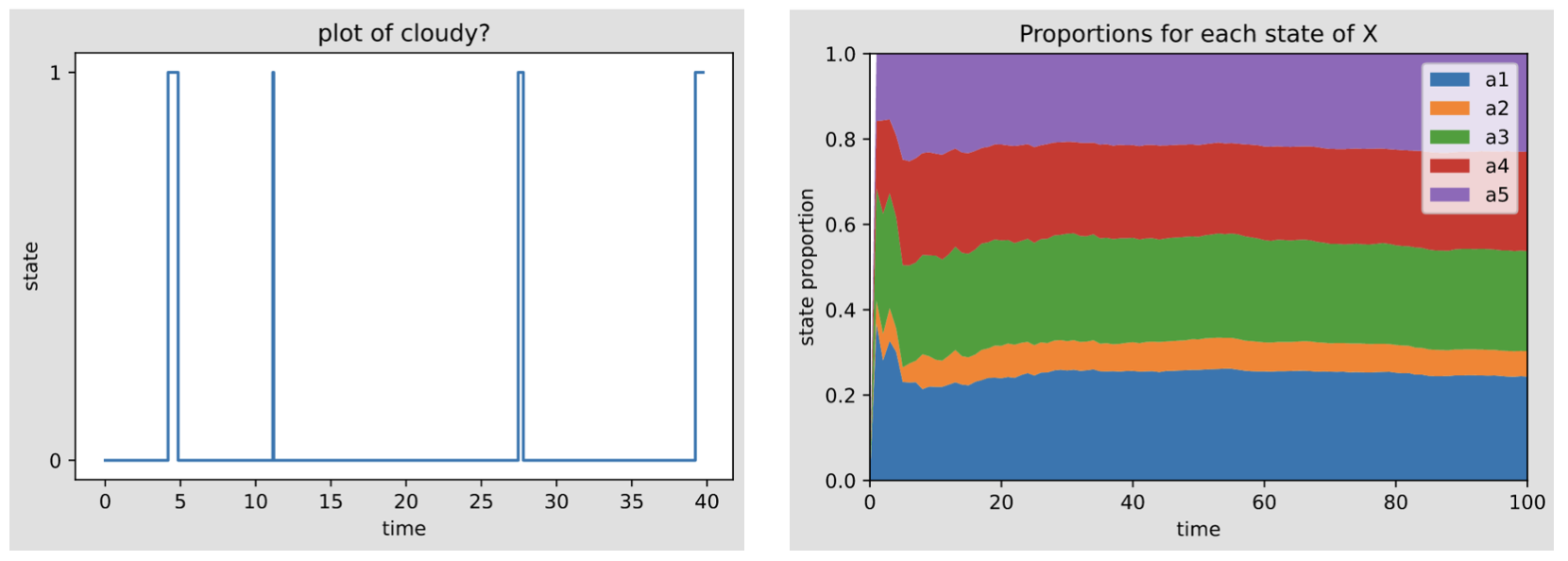
pyagrum.ctbn.plotTrajectory(v, traj, timeHorizon=None, plotname=None)
Section titled “pyagrum.ctbn.plotTrajectory(v, traj, timeHorizon=None, plotname=None)”Plot a variable’s trajectory using matplotlib.pyplot.
- Parameters:
- v (pyagrum.DiscreteVariable) – Variable to follow.
- traj (List [**Tuple [**float , str , str ] ]) – Trajectory to plot.
- timeHorizon (float) – Maximum time length to show.
- plotname (str) – Name of the plot.
pyagrum.ctbn.plotFollowVar(v, trajectories, timeHorizon=None, N=None, plotname=None)
Section titled “pyagrum.ctbn.plotFollowVar(v, trajectories, timeHorizon=None, N=None, plotname=None)”Plot the evolution (the proportions of the states the variable transition into) of a variable over time.
- Parameters:
- v (pyagrum.DiscreteVariable) – The variable to follow.
- trajectories (Dict [**int , List [**Tuple [**float , str , str ] ] ]) – Contains trajectories. The result is a mean over all the trajectories.
- timeHorizon (float) – Maximum time length to plot. If None, then the entire time length of the trajectories is used.
- N (int) – Number of division of interval [0, timeHorizon].
- plotname (str) – Name of the plot. If None, the picked name is “Proportions for each state of {v.name()}”.