


Jupyter notebook with Graphical Models
pyagrum.lib.notebook aims to facilitate the use of pyAgrum with jupyter notebook (or lab).
Visualization of graphical models
Section titled “Visualization of graphical models”Important
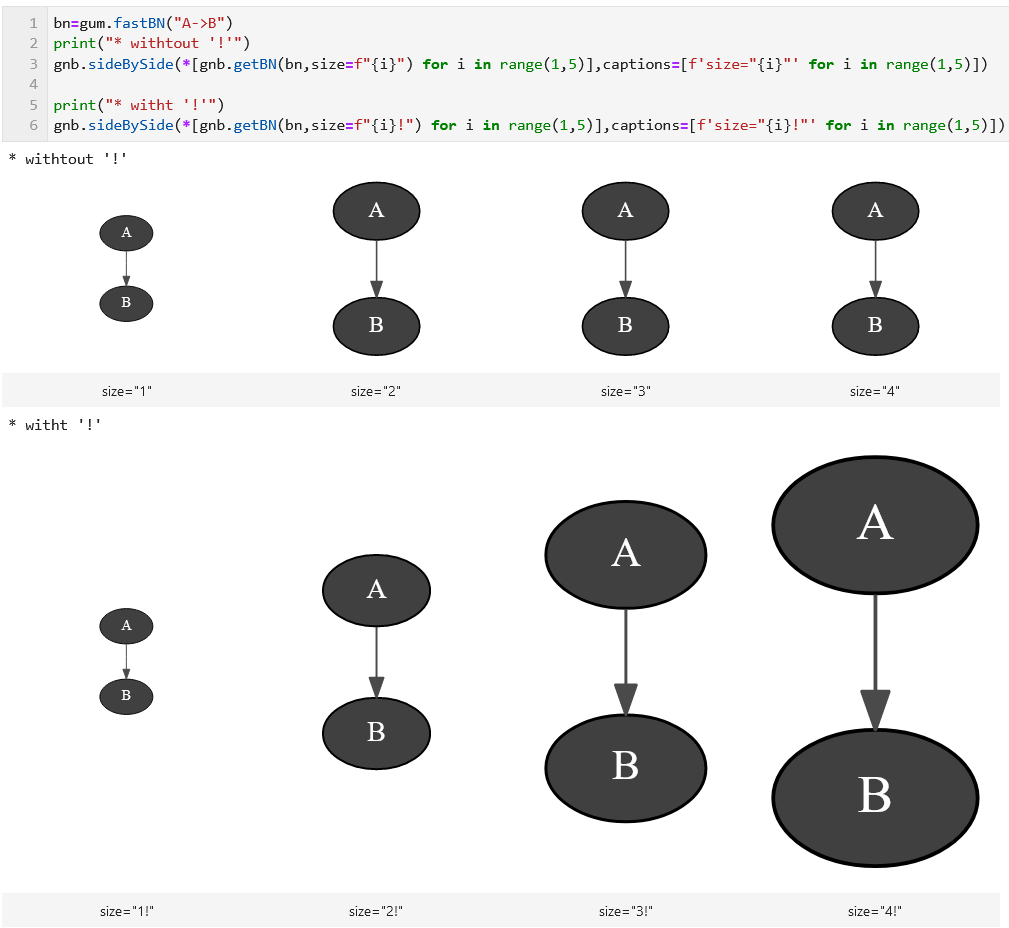
For many graphical representations functions, the parameter size is directly transferred to graphviz. Hence, Its format is a string containing an int. However if size ends in an exclamation point “!” (such as size=”4!”), then size is taken to be the desired minimum size. In this case, if both dimensions of the drawing are less than size, the drawing is scaled up uniformly until at least one dimension equals its dimension in size.
pyagrum.lib.notebook.showBN(bn, size=None, nodeColor=None, arcWidth=None, arcLabel=None, arcColor=None, cmapNode=None, cmapArc=None)
Section titled “pyagrum.lib.notebook.showBN(bn, size=None, nodeColor=None, arcWidth=None, arcLabel=None, arcColor=None, cmapNode=None, cmapArc=None)”show a Bayesian network
- Parameters:
- bn (pyagrum.BayesNet) – the Bayesian network
- size (str) – size (for graphviz) of the rendered graph
- nodeColor (dict [**Tuple (**int ,**int ) ,**float ]) – a nodeMap of values to be shown as color nodes (with special color for 0 and 1)
- arcWidth (dict [**Tuple (**int ,**int ) ,**float ]) – an arcMap of values to be shown as bold arcs
- arcLabel (dict [**Tuple (**int ,**int ) ,**str ]) – an arcMap of labels to be shown next to arcs
- arcColor (dict [**Tuple (**int ,**int ) ,**float ]) – an arcMap of values (between 0 and 1) to be shown as color of arcs
- cmapNode (ColorMap) – color map to show the vals of Nodes ( (if cmapEdge is None, this color map is used also for edges)
- cmapArc (ColorMap) – color map to show the vals of Arcs
- showMsg (dict) – a nodeMap of values to be shown as tooltip
pyagrum.lib.notebook.getBN(bn, size=None, nodeColor=None, arcWidth=None, arcLabel=None, arcColor=None, cmapNode=None, cmapArc=None)
Section titled “pyagrum.lib.notebook.getBN(bn, size=None, nodeColor=None, arcWidth=None, arcLabel=None, arcColor=None, cmapNode=None, cmapArc=None)”get a HTML string for a Bayesian network
- Parameters:
- bn (pyagrum.BayesNet) – the Bayesian network
- size (str) – size (for graphviz) of the rendered graph
- nodeColor (dict [**Tuple (**int ,**int ) ,**float ]) – a nodeMap of values to be shown as color nodes (with special color for 0 and 1)
- arcWidth (dict [**Tuple (**int ,**int ) ,**float ]) – an arcMap of values to be shown as bold arcs
- arcLabel (dict [**Tuple (**int ,**int ) ,**str ]) – an arcMap of labels to be shown next to arcs
- arcColor (dict [**Tuple (**int ,**int ) ,**float ]) – an arcMap of values (between 0 and 1) to be shown as color of arcs
- cmapNode (ColorMap) – color map to show the vals of Nodes
- cmapArc (ColorMap) – color map to show the vals of Arcs
- showMsg (dict) – a nodeMap of values to be shown as tooltip
- Returns: the desired representation of the Bayesian network
- Return type: pydot.Dot
pyagrum.lib.notebook.showInfluenceDiagram(diag, size=None)
Section titled “pyagrum.lib.notebook.showInfluenceDiagram(diag, size=None)”show an influence diagram as a graph
- Parameters:
- diag ( “pyagrum.InfluenceDiagram”) – the influence diagram
- size (str) – size (for graphviz) of the rendered graph
- Returns: the representation of the influence diagram
pyagrum.lib.notebook.getInfluenceDiagram(diag, size=None)
Section titled “pyagrum.lib.notebook.getInfluenceDiagram(diag, size=None)”get a HTML string for an influence diagram as a graph
- Parameters:
- diag ( “pyagrum.InfluenceDiagram”) – the influence diagram
- size (str) – size (for graphviz) of the rendered graph
- Returns: the HTML representation of the influence diagram
- Return type: str
pyagrum.lib.notebook.showMRF(mrf, view=None, size=None, nodeColor=None, factorColor=None, edgeWidth=None, edgeColor=None, cmapNode=None, cmapEdge=None)
Section titled “pyagrum.lib.notebook.showMRF(mrf, view=None, size=None, nodeColor=None, factorColor=None, edgeWidth=None, edgeColor=None, cmapNode=None, cmapEdge=None)”show a Markov random field
- Parameters:
- mrf ( “pyagrum.MarkovRandomField”) – the Markov random field
- view (str) – ‘graph’ | ‘factorgraph’ | None (default)
- size (str) – size (for graphviz) of the rendered graph
- nodeColor (Dict [**int ,**float ]) – a nodeMap of values (between 0 and 1) to be shown as color of nodes (with special colors for 0 and 1)
- factorColor (Dict [**int ,**float ]) – a function returning a value (between 0 and 1) to be shown as a color of factor. (used when view=’factorgraph’)
- edgeWidth (Dict [**Tuple [**int ,**int ] ,**float ]) – a edgeMap of values to be shown as width of edges (used when view=’graph’)
- edgeColor (Dict [**int ,**float ]) – a edgeMap of values (between 0 and 1) to be shown as color of edges (used when view=’graph’)
- cmapNode (Dict [**Tuple [**int ,**int ] ,**float ]) – color map to show the colors (if cmapEdge is None, this color map is used also for edges)
- cmapEdge ( “matplotlib.ColorMap”) – color map to show the edge color if distinction is needed
- Returns: the graph
pyagrum.lib.notebook.getMRF(mrf, view=None, size=None, nodeColor=None, factorColor=None, edgeWidth=None, edgeColor=None, cmapNode=None, cmapEdge=None)
Section titled “pyagrum.lib.notebook.getMRF(mrf, view=None, size=None, nodeColor=None, factorColor=None, edgeWidth=None, edgeColor=None, cmapNode=None, cmapEdge=None)”get an HTML string for a Markov random field
- Parameters:
- mrf ( “pyagrum.MarkovRandomField”) – the Markov random field
- view (str) – ‘graph’ | ‘factorgraph’ | None (default)
- size (str) – size (for graphviz) of the rendered graph
- nodeColor (Dict [**str ,**float ]) – a nodeMap of values (between 0 and 1) to be shown as color of nodes (with special colors for 0 and 1)
- factorColor (Dict [**str ,**float ]) – a function returning a value (beeween 0 and 1) to be shown as a color of factor. (used when view=’factorgraph’)
- edgeWidth (Dict [**Tuple [**str ,**str ] ,**float ]) – a edgeMap of values to be shown as width of edges (used when view=’graph’)
- edgeColor (Dict [**Tuple [**str ,**str ] ,**float ]) – a edgeMap of values (between 0 and 1) to be shown as color of edges (used when view=’graph’)
- cmapNode (matplotlib.ColorMap) – color map to show the colors (if cmapEdge is None, cmapNode is used for edges)
- cmapEdge (matplotlib.ColorMap) – color map to show the edge color if distinction is needed
- Returns: the graph
pyagrum.lib.notebook.showCN(cn, size=None, nodeColor=None, arcWidth=None, arcLabel=None, arcColor=None, cmapNode=None, cmapArc=None)
Section titled “pyagrum.lib.notebook.showCN(cn, size=None, nodeColor=None, arcWidth=None, arcLabel=None, arcColor=None, cmapNode=None, cmapArc=None)”show a credal network
- Parameters:
- cn (pyagrum.CredalNet) – the Credal network
- size (str) – size (for graphviz) of the rendered graph
- nodeColor (dict [**int ,**float ]) – a nodeMap of values to be shown as color nodes (with special color for 0 and 1)
- arcWidth (dict [**Tuple (**int ,**int ) ,**float ]) – an arcMap of values to be shown as bold arcs
- arcLabel (dict [**Tuple (**int ,**int ) ,**float ]) – an arcMap of labels to be shown next to arcs
- arcColor (dict [**Tuple (**int ,**int ) ,**float ]) – an arcMap of values (between 0 and 1) to be shown as color of arcs
- cmapNode (matplotlib.color.colormap) – color map to show the vals of Nodes
- cmapArc (matplotlib.color.colormap) – color map to show the vals of Arcs
- showMsg (dict [**int ,**str ]) – a nodeMap of values to be shown as tooltip
- Returns: the graph
pyagrum.lib.notebook.getCN(cn, size=None, nodeColor=None, arcWidth=None, arcLabel=None, arcColor=None, cmapNode=None, cmapArc=None)
Section titled “pyagrum.lib.notebook.getCN(cn, size=None, nodeColor=None, arcWidth=None, arcLabel=None, arcColor=None, cmapNode=None, cmapArc=None)”get a HTML string for a credal network
- Parameters:
- cn (pyagrum.CredalNet) – the Credal network
- size (str) – size (for graphviz) of the rendered graph
- nodeColor (dict [**int ,**float ]) – a nodeMap of values to be shown as color nodes (with special color for 0 and 1)
- arcWidth (dict [**Tuple (**int ,**int ) ,**float ]) – an arcMap of values to be shown as bold arcs
- arcLabel (dict [**Tuple (**int ,**int ) ,**float ]) – an arcMap of labels to be shown next to arcs
- arcColor (dict [**Tuple (**int ,**int ) ,**float ]) – an arcMap of values (between 0 and 1) to be shown as color of arcs
- cmapNode (matplotlib.color.colormap) – color map to show the vals of Nodes
- cmapArc (matplotlib.color.colormap) – color map to show the vals of Arcs
- showMsg (dict [**int ,**str ]) – a nodeMap of values to be shown as tooltip
- Returns: the desired representation of the Credal Network
- Return type: pydot.Dot
pyagrum.lib.notebook.showInference(model, **kwargs)
Section titled “pyagrum.lib.notebook.showInference(model, **kwargs)”show pydot graph for an inference in a notebook
- Parameters:
- model (pyagrum.GraphicalModel) – the model in which to infer (pyagrum.BayesNet, pyagrum.MarkovRandomField or pyagrum.InfluenceDiagram)
- engine (gum.Inference) – inference algorithm used. If None, gum.LazyPropagation will be used for BayesNet, gum.ShaferShenoy for gum.MarkovRandomField and gum.ShaferShenoyLIMIDInference for gum.InfluenceDiagram.
- evs (Dict [**int |**str ,**int |**str |**List [**float ] ]) – map of evidence
- targets (Set [**str ]) – set of targets
- size (string) – size (for graphviz) of the rendered graph
- nodeColor (Dict [**str ,**float ]) – a nodeMap of values (between 0 and 1) to be shown as color of nodes (with special colors for 0 and 1)
- factorColor (Dict [**int ,**float ]) – a nodeMap of values (between 0 and 1) to be shown as color of factors (in MarkovRandomField representation)
- arcWidth ( : Dict [ (**str ,**str ) ,**float ]) – an arcMap of values to be shown as width of arcs
- arcColor ( : Dict [ (**str ,**str ) ,**float ]) – a arcMap of values (between 0 and 1) to be shown as color of arcs
- cmapNode (matplotlib.ColorMap) – map to show the color of nodes and arcs
- cmapArc (matplotlib.ColorMap) – color map to show the vals of Arcs.
- graph (pyagrum.Graph) – only shows nodes that have their id in the graph (and not in the whole BN)
- view (str) – graph | factorgraph | None (default) for Markov random field
- Returns: the desired representation of the inference
pyagrum.lib.notebook.getInference(model, **kwargs)
Section titled “pyagrum.lib.notebook.getInference(model, **kwargs)”get a HTML string for an inference in a notebook
- Parameters:
- model (pyagrum.GraphicalModel) – the model in which to infer (pyagrum.BayesNet, pyagrum.MarkovRandomField or pyagrum.InfluenceDiagram)
- engine (gum.Inference) – inference algorithm used. If None, gum.LazyPropagation will be used for BayesNet, gum.ShaferShenoy for gum.MarkovRandomField and gum.ShaferShenoyLIMIDInference for gum.InfluenceDiagram.
- evs (Dict [**int |**str ,**int |**str |**List [**float ] ]) – map of evidence
- targets (Set [**str ]) – set of targets
- size (string) – size (for graphviz) of the rendered graph
- nodeColor (Dict [**str ,**float ]) – a nodeMap of values (between 0 and 1) to be shown as color of nodes (with special colors for 0 and 1)
- factorColor (Dict [**int ,**float ]) – a nodeMap of values (between 0 and 1) to be shown as color of factors (in MarkovRandomField representation)
- arcWidth ( : Dict [ (**str ,**str ) ,**float ]) – an arcMap of values to be shown as width of arcs
- arcColor ( : Dict [ (**str ,**str ) ,**float ]) – a arcMap of values (between 0 and 1) to be shown as color of arcs
- cmapNode (matplotlib.ColorMap) – map to show the color of nodes and arcs
- cmapArc (matplotlib.ColorMap) – color map to show the vals of Arcs.
- graph (pyagrum.Graph) – only shows nodes that have their id in the graph (and not in the whole BN)
- view (str) – graph | factorgraph | None (default) for Markov random field
- Returns: the desired representation of the inference
pyagrum.lib.notebook.showJunctionTree(bn, withNames=True, size=None)
Section titled “pyagrum.lib.notebook.showJunctionTree(bn, withNames=True, size=None)”Show a junction tree of a Bayesian network
- Parameters:
- bn (pyagrum.BayesNet) – the model
- withNames (bool) – names or id in the graph (names can created very large nodes)
- size (float |**str) – size (for graphviz) of the rendered graph
pyagrum.lib.notebook.getJunctionTree(bn, withNames=True, size=None)
Section titled “pyagrum.lib.notebook.getJunctionTree(bn, withNames=True, size=None)”get a HTML string for a junction tree (more specifically a join tree)
- Parameters:
- bn ( “pyagrum.BayesNet”) – the Bayesian network
- withNames (Boolean) – display the variable names or the node id in the clique
- size (str) – size (for graphviz) of the rendered graph
- Returns: str : the HTML representation of the graph
Visualization of Tensors
Section titled “Visualization of Tensors”pyagrum.lib.notebook.showProba(p, scale=None)
Section titled “pyagrum.lib.notebook.showProba(p, scale=None)”Show a mono-dim Tensor (a marginal)
- Parameters:
- p (pyagrum.Tensor) – the marginal to show
- scale (float) – the zoom factor
pyagrum.lib.notebook.getPosterior(bn, evs, target)
Section titled “pyagrum.lib.notebook.getPosterior(bn, evs, target)”shortcut for proba2histo(gum.getPosterior(bn,evs,target))
- Parameters:
- bn ( “pyagrum.BayesNet”) – the BayesNet
- evs (Dict [**str |**int:int |**str |**List [**float ] ]) – map of evidence
- target (str |**int) – name of target variable
- Returns: the matplotlib graph
pyagrum.lib.notebook.showPosterior(bn, evs, target)
Section titled “pyagrum.lib.notebook.showPosterior(bn, evs, target)”shortcut for showProba(gum.getPosterior(bn,evs,target))
- Parameters:
- bn ( “pyagrum.BayesNet”) – the BayesNet
- evs (Dict [**str |**int:int |**str |**List [**float ] ]) – map of evidence
- target (str |**int) – name of target variable
pyagrum.lib.notebook.getTensor(pot, digits=None, withColors=None, varnames=None)
Section titled “pyagrum.lib.notebook.getTensor(pot, digits=None, withColors=None, varnames=None)”return a HTML string of a gum.Tensor as a HTML table. The first dimension is special (horizontal) due to the representation of conditional probability table
- Parameters:
- pot (gum.Tensor) – the tensor to show
- digits (int) – number of digits to show
- withColors (bool) – background for proba cells or not
- varnames (List [**str ]) – the aliases for variables name in the table
- Returns: the html representation of the Tensor (as a string)
- Return type: str
pyagrum.lib.notebook.showTensor(pot, digits=None, withColors=None, varnames=None)
Section titled “pyagrum.lib.notebook.showTensor(pot, digits=None, withColors=None, varnames=None)”show a gum.Tensor as a HTML table. The first dimension is special (horizontal) due to the representation of conditional probability table
- Parameters:
- pot (gum.Tensor) – the tensor to show
- digits (int) – number of digits to show
- withColors (bool) – background color for proba cells or not
- varnames (List [**str ]) – the aliases for variables name in the table
Visualization of graphs
Section titled “Visualization of graphs”pyagrum.lib.notebook.getDot(dotstring, size=None)
Section titled “pyagrum.lib.notebook.getDot(dotstring, size=None)”get an HTML representation of a dot string
- Parameters:
- dotstring (str) – the dot string
- size (float |**str) – size (for graphviz) of the rendered graph
- Return type:
str - Returns: the HTML representation of the dot string
pyagrum.lib.notebook.showDot(dotstring, size=None)
Section titled “pyagrum.lib.notebook.showDot(dotstring, size=None)”show a dot string as a graph
- Parameters:
- dotstring (str) – the dot string
- size (float |**str) – size (for graphviz) of the rendered graph
pyagrum.lib.notebook.getGraph(gr, size=None)
Section titled “pyagrum.lib.notebook.getGraph(gr, size=None)”get an HTML representation of a pydot graph
- Parameters:
- gr (pydot.Dot) – the graph
- size (float |**str) – the size (for graphviz) of the rendered graph
- Returns: the HTML representation of the graph (as a string)
- Return type: str
pyagrum.lib.notebook.showGraph(gr, size=None)
Section titled “pyagrum.lib.notebook.showGraph(gr, size=None)”show a pydot graph in a notebook
- Parameters:
- gr (pydot.Dot) – the graph
- size (float |**str) – the size (for graphviz) of the rendered graph
Visualization of approximation algorithm
Section titled “Visualization of approximation algorithm”pyagrum.lib.notebook.animApproximationScheme(apsc, scale=<ufunc ‘log10’>)
Section titled “pyagrum.lib.notebook.animApproximationScheme(apsc, scale=<ufunc ‘log10’>)”show an animated version of an approximation algorithm
- Parameters:
- apsc – the approximation algorithm
- scale – a function to apply to the figure
Helpers
Section titled “Helpers”pyagrum.lib.notebook.configuration()
Section titled “pyagrum.lib.notebook.configuration()”Display the collection of dependance and versions
pyagrum.lib.notebook.sideBySide(*args, **kwargs)
Section titled “pyagrum.lib.notebook.sideBySide(*args, **kwargs)”display side by side args as HMTL fragment (using string, _reprhtml() or str())
- Parameters:
- args (str) – HMTL fragments as string arg, arg.repr_html() or str(arg)
- captions (List [**str ] , optional) – list of captions
- valign (str) – vertical position in the row (top|middle|bottom, middle by default)
- ncols (int) – number of columns (infinite by default)