


pyAgrum’s modular architecture
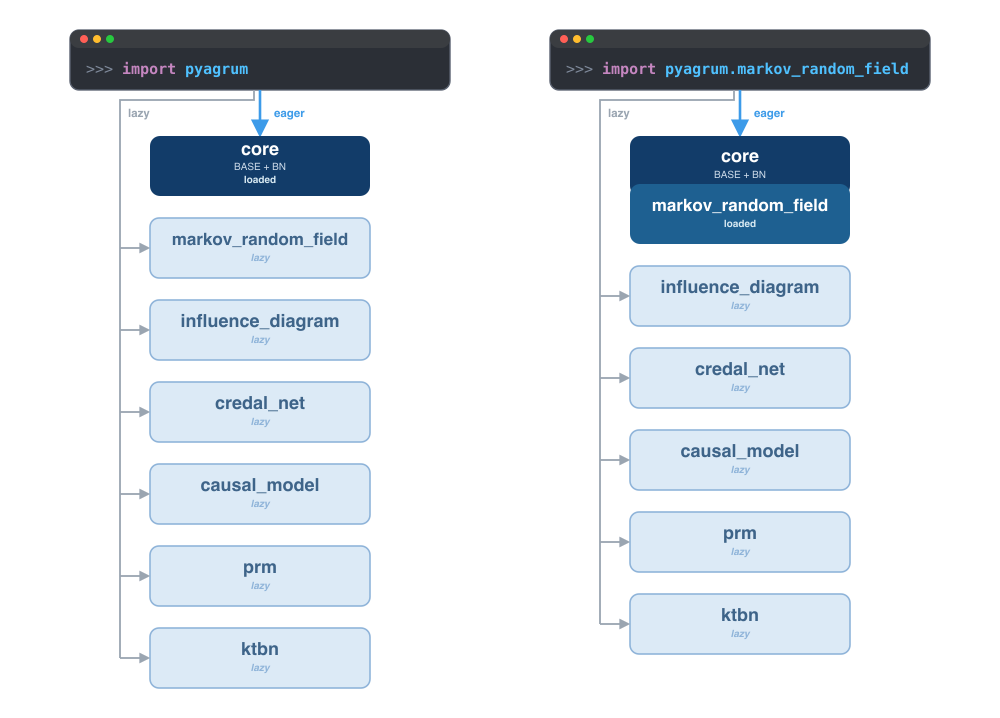
Note
This page is only about the compiled part of pyAgrum: the C++/aGrUM
code exported through SWIG. pyagrum is not a single compiled
extension: it is a lightweight core (Bayesian networks and every
fundamental component – graphs, variables, tensors…) plus six
optional submodules, each compiled as its own independent extension –
one per probabilistic graphical model family beyond BN, plus
pyagrum.ktbn (k-order dynamic Bayesian networks). All six are
reachable lazily (see below).
pyAgrum also ships several pure-Python modules – pyagrum.lib (notebook display, image export, …),
pyagrum.causal, pyagrum.ctbn,
pyagrum.clg, pyagrum.bnmixture,
pyagrum.skbn, pyagrum.explain… These are ordinary
Python packages layered on top of the compiled core: plain import
statements, no lazy-loading shim, nothing described on this page applies
to them.
| Package | Content | Main classes | Reachable lazily? |
|---|---|---|---|
pyagrum | core: graphs, variables, Tensor, Bayesian networks,BN inference and learning | BayesNet, LazyPropagation,BNLearner… | always loaded |
pyagrum.markov_random_field | Markov random fields | MarkovRandomField, ShaferShenoyMRFInference | yes |
pyagrum.influence_diagram | Influence diagrams and LIMIDs | InfluenceDiagram, ShaferShenoyLIMIDInference, IDGenerator | yes |
pyagrum.credal_net | Credal networks | CredalNet, CNLoopyPropagation, CNMonteCarloSampling | yes |
pyagrum.causal_model | Causal models (causal inference, counterfactuals) | CausalModel, CausalImpact, Counterfactual | yes |
pyagrum.prm | Probabilistic relational models (o3prm) | PRMexplorer | partially (see below) |
pyagrum.ktbn | k-order dynamic Bayesian networks | KTBN, KTBNInference, KTBNLearner | yes |
Splitting the C++/SWIG extension this way keeps a plain import pyagrum
fast and light: a script that only ever builds and queries Bayesian networks
never pays the cost of loading the credal-network or causal-inference
machinery.
Two ways to use a submodule
Section titled “Two ways to use a submodule”1. Just use it – lazy loading. Every class and function above is
directly reachable from the pyagrum namespace, without importing the
submodule explicitly:
import pyagrum as gum
mrf = gum.MarkovRandomField()  # transparently imports pyagrum.markov_random_field on first useie = gum.ShaferShenoyMRFInference(mrf)
The first access to a name owned by a submodule (MarkovRandomField,
InfluenceDiagram, CredalNet, CausalModel, KTBN…) imports
that submodule behind the scenes and caches the result – every later access
is a plain attribute lookup, no import overhead. If the submodule was
excluded from the build (see Optional submodules below), the same
call raises an AttributeError instead of silently doing nothing.
2. Scope the import explicitly. Each submodule can also be imported on its own, as a drop-in superset of the core namespace:
import pyagrum.markov_random_field as gum
bn = gum.BayesNet()               # still available: the core is re-exportedmrf = gum.MarkovRandomField()      # no lazy-loading step needed, already imported
This is exactly the pattern used throughout pyAgrum’s own test suite for single-model scripts: it documents at the top of the file which model family is in use, and avoids the (negligible but nonzero) first-access import cost.
The lazy-loading mechanism
Section titled “The lazy-loading mechanism”The trick is a module-level __getattr__ on pyagrum itself (PEP 562): accessing an attribute that is not
already defined in the core namespace triggers a lookup in a small table
mapping names to the submodule that owns them, imports that submodule with
importlib, and re-binds the name directly into pyagrum’s namespace
so every subsequent access skips the indirection entirely. This is the same
mechanism used by other lazily-loaded packages: the submodule is only ever
imported if the program actually uses it.
A handful of convenience type aliases – DirectedModel, PGM,
MRFInference, CNInference, IDInference – span several
submodules at once (e.g. PGM covers BN, MRF, ID and CN). Accessing one
of these imports every submodule it spans, not just one; they are rarely
needed in everyday code and mostly useful for type annotations.
Optional submodules
Section titled “Optional submodules”Each submodule can be excluded from a given pyAgrum build (see the
PYAGRUM_WITH_MRF / _ID / _CN / _CM / _PRM / _KTBN build options)
– for instance a minimal deployment that only ever needs Bayesian networks.
When a submodule was left out, accessing any of its names raises a plain
AttributeError rather than an import error deep in unrelated code, and
import pyagrum.markov_random_field (etc.) fails with the usual ModuleNotFoundError.
The pyagrum.prm special case
Section titled “The pyagrum.prm special case”pyagrum.prm behaves slightly differently from the five fully-lazy submodules above.
Its PRMexplorer class is reachable lazily like everything else, but
O3PRM file support on BayesNet –
BayesNet.loadO3PRM/saveO3PRM, and the "O3PRM" extension of
loadBN()/saveBN() – is not: these methods
only exist once pyagrum.prm has actually been imported, because
pyagrum.prm attaches them onto the core BayesNet class itself on
import rather than exposing them as free-standing names. Calling
gum.loadBN("model.o3prm") without ever having imported pyagrum.prm
raises an explicit error asking for import pyagrum.prm:
import pyagrum as gum
gum.loadBN("model.o3prm")## InvalidArgument: loading a .o3prm file requires 'import pyagrum.prm' first
import pyagrum.prm  # registers BayesNet.loadO3PRM/saveO3PRMgum.loadBN("model.o3prm")  # now works