Parametric EM (missing data)
 |  |  |
import pyagrum as gumimport pyagrum.lib.notebook as gnb

## the databases will be saved in "out/*.csv"EMnomissing = "out/EM_nomissing.csv"EMmissing = "out/EM_missing.csv"
Generating data with missing values (at random)
Section titled “Generating data with missing values (at random)”src = gum.fastBN("A->B<-C->D->E<-B;D->F")gum.generateSample(src, 5000, EMnomissing, random_order=False)srcimport pandas as pdimport numpy as np
def add_missing(src, dst, proba): df = pd.read_csv(src) mask = np.random.choice([True, False], size=df.shape, p=[proba, 1 - proba]) df.mask(mask).to_csv(dst, na_rep="?", index=False, float_format="%.0f")
gum.generateSample(src, 5000, EMnomissing, random_order=False)add_missing(EMnomissing, EMmissing, proba=0.1)print("No missing")with open(EMnomissing, "r") as srcfile: for _ in range(10): print(srcfile.readline(), end="")print("Missing")with open(EMmissing, "r") as srcfile: for _ in range(10): print(srcfile.readline(), end="")No missingA,B,C,D,E,F0,1,1,0,1,10,0,1,1,1,01,1,1,0,1,10,0,1,0,1,01,1,1,0,1,01,0,1,0,1,10,1,1,0,1,00,1,1,1,1,10,1,1,0,0,1MissingA,B,C,D,E,F?,1,1,0,1,10,0,1,1,1,01,1,1,0,1,10,0,1,0,1,01,1,1,0,1,01,0,1,0,1,10,1,1,0,1,00,1,1,1,?,10,1,1,0,0,1Basic learning with missing data
Section titled “Basic learning with missing data”Now we create the BNLearner, specifying:
- the filename of the database
- a Bayes net (src) that enables to easily specify the random variables of interest in this database as well as their features (domain, name, type, etc.)
- a list of the strings encoding the missing data in the database
learner = gum.BNLearner(EMmissing, src, ["?"])print(f"Missing values in {EMmissing} : {learner.hasMissingValues()}")Missing values in out/EM_missing.csv : TrueLearning the parameters of a Bayes net makes sense only for a given network structure since
they are the parameters of the conditional probability tables of the nodes (random variables)
given their parents in the graph. So, below, we pass in argument to Method learnParameter()
the graphical structure of Bayes net src. This is the most basic way of learning Bayes net
parameters with a BNLearner.
Note that, by default, the BNLearner is not capable of estimating parameters from a database that contains missing values. Indeed, this requires a way to impute these missing values in order to avoid introducing biases and we do not want to enforce a specific way to do so (for instance to enforce using EM while the missing data are not missing completely at random).
try: learner.learnParameters(src.dag())except gum.MissingValueInDatabase: print("Learning is not possible without EM if there are some missing values.")Learning is not possible without EM if there are some missing values.In this tutorial, the data are missing completely at random (MCAR), so we can safely indicate to the BNLearner that we wish to use EM to impute missing values using the Expectation/Maximization (EM) algorithm.
EM iterates expectation/maximizations steps, so we need some criteria to determine when it
is appropriate to stop these iterations. Method useEM() both lets the BNLearner know
that it must use EM and sets the primary stopping criterion of the algorithm to be the
min log-likelihood evolution rate, i.e., at each iteration, EM computes the log-likelihood
of the data (after imputation). Let and be the log-likelihoods at the current
and the previous iterations respectively. Then, useEM(1e-4) specifies that EM should stop when
.
The “primary” stopping criterion refers to the fact that we can specify several criteria, including a maximal number of iterations (MaxIter), a timeout (MaxTime). In the case where several criteria are specified, then EM stops when at least one criterion is not met. Printing the BNLearner, as shown below, shows you which stopping criteria EM uses.
learner.useEM(1e-4)
## at each iteration, EM estimates the parameters using a learning score and a prior.## you can specify which ones you wish to uselearner.useSmoothingPrior()print(learner)
## to be user-frendly, these methods can be chained:learner.useEM(1e-3).useSmoothingPrior().useScoreAIC()
## perform the parameter learning using EMbn = learner.learnParameters(src.dag())gnb.flow.row(  gnb.getInference(src),  gnb.getInference(bn),  captions=["Source", f"EM Estimation after {learner.EMnbrIterations()} iteration(s)"],)
Filename : out/EM_missing.csvSize : (5000,6)Variables : A[2], B[2], C[2], D[2], E[2], F[2]Induced types : FalseMissing values : TrueAlgorithm : MIICCorrection : MDLPrior : SmoothingPrior weight : 1.000000use EM : TrueEM stopping criteria : [MinRate: 1e-04, MaxIter: 10000]It may be interesting to know for which reason EM stopped its iterations. Method EMStateMessage() allows
you to know it. Notably, it is well-known that, using EM, the log-likelihood always
increases and will therefore converge. But, actually, this common knowledge is not
entirely accurate and it may happen, although this is very very unlikely, that the
log-likelihood decreases and diverges. See Table 5 on p28 of
EM_collins97.pdf.
In such a case, the BNLearner’s EM algorithm returns the Bayes net with the highest
log-likelihood parameters and issues a warning. Method EMStateMessage() will then report
that EM has been stopped to avoid a log-likelihood divergence.
print("EM 1", learner.EMStateMessage())
## here, in addition to the log-likelihood min rate, we limit the number of iterationslearner.EMsetMaxIter(2)bn = learner.learnParameters(src.dag())print("EM 2", learner.EMStateMessage())
EM 1 stopped with rate=0.001EM 2 stopped with max iteration=2Sometimes, it is more convenient to get the state as an integer so that a program can handle it.
In this case, prefer using Method EMStateApproximationScheme(). The documentation of this method explains
the meanings of the returned numbers.
print("state =", learner.EMStateApproximationScheme())
help(gum.BNLearner.EMStateApproximationScheme)
state = 4Help on function EMStateApproximationScheme in module pyagrum.pyagrumcpp:
EMStateApproximationScheme(self) -> int Returns an int representing the state of the EM algorithm.
The possible states are: 0. Undefined 1. Continue: EM has not been stopped yet 2. Epsilon: EM has been stopped due to the min log-likelihood difference stopping criterion 3. Rate: EM has been stopped due to the min log-likelihood evolution rate stopping criterion 4. Limit: EM has been stopped due to a limit on the number of iterations 5. TimeLimit: EM has been stopped due to a timeout 6. Stopped: EM has been stopped because there was a divergence on the log-likelihoodIf the data are not missing at random, we should not use EM. We can forbid it
specifying a rate of 0.0 in method useEM() or, preferably, using Method forbidEM().
learner.forbidEM()
try:  bn = learner.learnParameters(src.dag())except gum.MissingValueInDatabase:  print("Learning is not possible without EM if there are some missing values.")
Learning is not possible without EM if there are some missing values.Learning with smaller error (and no smoothing)
Section titled “Learning with smaller error (and no smoothing)”learner = gum.BNLearner(EMmissing, src, ["?"])
## here, we use EM in verbose mode in order to keep track of the log-likelihoods## computed. This will allow us to plot them in the next notebook cell.learner.useEM(1e-8).EMsetVerbosity(True)
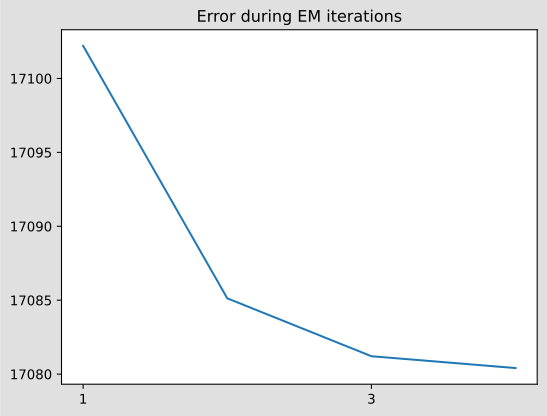
bn2 = learner.learnParameters(src.dag())gnb.flow.row( gnb.getInference(src), gnb.getInference(bn2), captions=["Source", f"EM Estimation after {learner.EMnbrIterations()} iteration(s)"],)import matplotlib.pyplot as plt
## display -log-likelihoodplt.plot(np.arange(1, 1 + learner.EMnbrIterations()), learner.EMHistory())plt.xticks(np.arange(1, 1 + learner.EMnbrIterations(), step=2))plt.title("Error during EM iterations");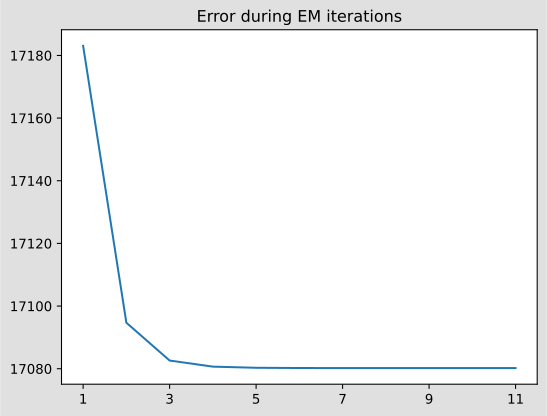
Setting EM’s stopping criteria
Section titled “Setting EM’s stopping criteria”There are 3 methods to enable EM:
useEM()that, implicitly, sets the log-likelihood evolution rate as the primary stopping criterionuseEMWithRateCriterion(), which is an alias for useEM()useEMWithDiffCriterion(), which sets the difference between two consecutive log-likelihoods as the primary stopping criterion
## here, we enable EM and enforce that it will stop when the log-likelihood## evolution rate drops below 1e-3print("learning with the min log-likelihood evolution rate criterion")learner.useEMWithRateCriterion(1e-3)learner.learnParameters(src.dag())print(learner.EMStateMessage())
plt.figure()plt.plot(np.arange(1, 1 + learner.EMnbrIterations()), learner.EMHistory())plt.xticks(np.arange(1, 1 + learner.EMnbrIterations(), step=2))plt.title("Error during EM iterations")plt.show()
## setting EM to stop when the difference between two consecutive log-likelihood## drops below 0.5print("learning with the min log-likelihood difference criterion")learner.useEMWithDiffCriterion(0.5)learner.learnParameters(src.dag())print(learner.EMStateMessage())
plt.figure()plt.plot(np.arange(1, 1 + learner.EMnbrIterations()), learner.EMHistory())plt.xticks(np.arange(1, 1 + learner.EMnbrIterations(), step=2))plt.title("log-likelihood differences during EM iterations")plt.show()
learning with the min log-likelihood evolution rate criterionstopped with rate=0.001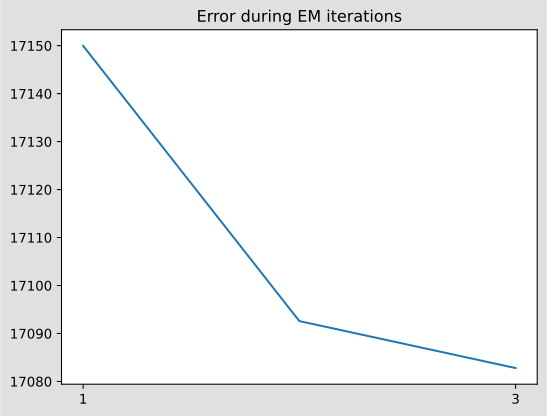
learning with the min log-likelihood difference criterionstopped with epsilon=0.5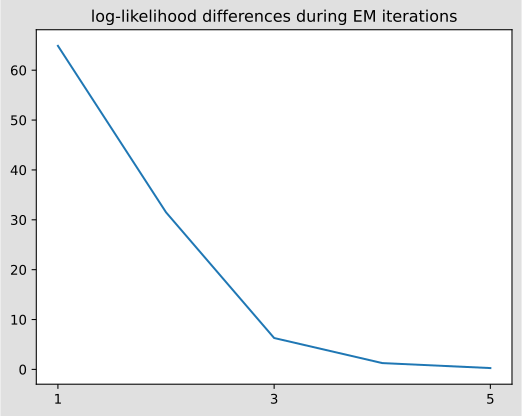
It is possible to specify several stopping criteria. In this case, EM stops
when at least one of the criteria is not met.
Note that Min log-likelihood difference and Min-log-likelihood evolution rate
are mutually exclusive.
## the following learner will stop whenever the difference between two consecutive## log-likelihoods drops below 0.5 OR whenever it has performed 4 iterations OR## whenever it has already been executed for 200 milliseconds.learner.useEMWithDiffCriterion(0.5).EMsetMaxIter(4).EMsetMaxTime(200)
print(learner)
Filename : out/EM_missing.csvSize : (5000,6)Variables : A[2], B[2], C[2], D[2], E[2], F[2]Induced types : FalseMissing values : TrueAlgorithm : MIICCorrection : MDLPrior : -use EM : TrueEM stopping criteria : [MinDiff: 0.5, MaxIter: 4, MaxTime: 200]## Of course, it is always possible to disable previously selected criteriaprint(learner)
## remove the max iter criterion and the min diff criterionlearner.EMdisableMaxIter().EMdisableEpsilon()
print("================================")print(learner)Filename : out/EM_missing.csvSize : (5000,6)Variables : A[2], B[2], C[2], D[2], E[2], F[2]Induced types : FalseMissing values : TrueAlgorithm : MIICCorrection : MDLPrior : -use EM : TrueEM stopping criteria : [MinDiff: 0.5, MaxIter: 4, MaxTime: 200]
================================Filename : out/EM_missing.csvSize : (5000,6)Variables : A[2], B[2], C[2], D[2], E[2], F[2]Induced types : FalseMissing values : TrueAlgorithm : MIICCorrection : MDLPrior : -use EM : TrueEM stopping criteria : [MaxTime: 200]Initializing the EM algorithm
Section titled “Initializing the EM algorithm”The EM’s philosophy consists of imputing missing values using the Bayes net learnt at the previous iteration. This means that it requires an initial model. When using Method learnParameter(dag), this initial model has the graphical structure corresponding to dag, and its parameters are learnt using an estimator that does not take into account the missing values.
The conditional probability tables (CPT) of the initial Bayes net are then perturbed, so that we can execute EM with multi-starts. More precisely, the CPTs are perturbed using the following formula: where is a real number belonging to interval .
learner = gum.BNLearner(EMmissing, src, ["?"])
## by default, useEM specifies a default noise equal to 0.1learner.useEM(1e-6).EMsetVerbosity(True)
## use the pyagrum estimator to initialize EM's CPTs and perturb them## with the default 0.1 noiselearner.learnParameters(src.dag())
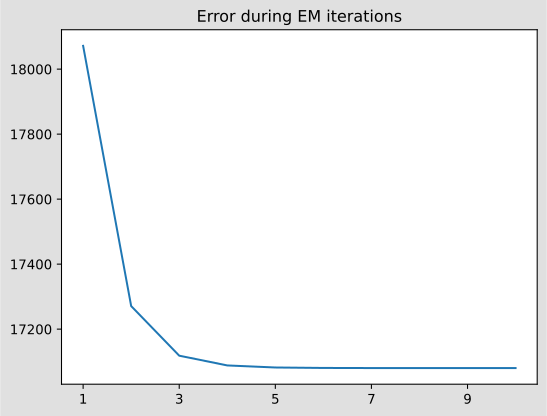
plt.figure()plt.plot(np.arange(1, 1 + learner.EMnbrIterations()), learner.EMHistory())plt.xticks(np.arange(1, 1 + learner.EMnbrIterations(), step=2))plt.title("Error during EM iterations")## define another noiselearner.useEM(1e-6, 0.9)  # noise = 0.9learner.learnParameters(src.dag())
plt.figure()plt.plot(np.arange(1, 1 + learner.EMnbrIterations()), learner.EMHistory())plt.xticks(np.arange(1, 1 + learner.EMnbrIterations(), step=2))plt.title("Error during EM iterations");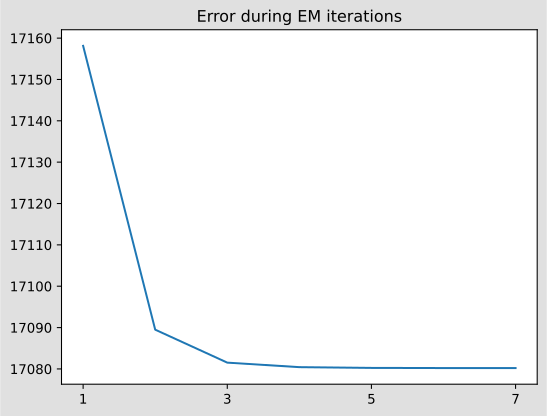
In the above cell, before perturbing the CPTs of the EM’s initial model,
those were estimated from the dataset. This prevents exploiting user knowledge.
To fix this issue, instead of passing a DAG as a parameter to Method
learnParameters(), it is possible to pass a Bayes net. In this
case, for the CPTs of this Bayes net that are fully filled with zeroes, EM’s
initial CPTs are estimated as described above, but the other CPTs are considered
as the initial values to be taken into account before the noise perturbations.
## first learning with EMlearner.useEM(1e-6, 0.9)bn = learner.learnParameters(src.dag())
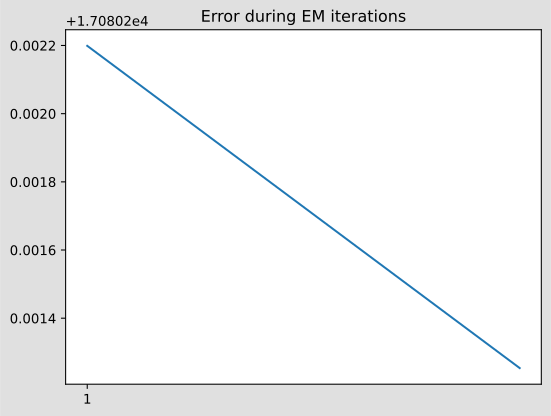
plt.figure()plt.plot(np.arange(1, 1 + learner.EMnbrIterations()), learner.EMHistory())plt.xticks(np.arange(1, 1 + learner.EMnbrIterations(), step=2))plt.title("Error during EM iterations")## relaunch EM but initializing the CPTs with those of bnlearner.useEM(1e-6, 0.0)  # no noiselearner.learnParameters(bn)
plt.figure()plt.plot(np.arange(1, 1 + learner.EMnbrIterations()), learner.EMHistory())plt.xticks(np.arange(1, 1 + learner.EMnbrIterations(), step=2))plt.title("Error during EM iterations");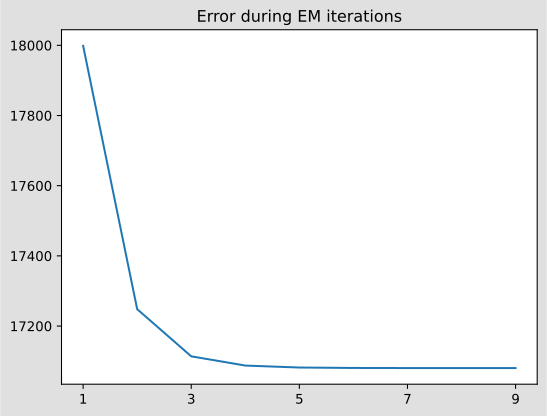
## of course, not all the CPTs need be initialized by the userbn.cpt("A").fillWith([0.0] * 2)bn.cpt("B").fillWith([0.0] * 8)bn.cpt("D").fillWith([0.0] * 4)bn.cpt("F").fillWith([0.0] * 4)
gnb.sideBySide(  bn.cpt("A"),  bn.cpt("B"),  bn.cpt("C"),)
gnb.sideBySide(bn.cpt("D"), bn.cpt("E"), bn.cpt("F"))The CPTs of and are initialized as shown in the preceding cell, the other ones are estimated from the database. Then all the CPTs are perturbed and EM starts its expectation/maximization iterations
learner.useEM(1e-4)learner.setVerbosity(True)bn = learner.learnParameters(bn)
plt.figure()plt.plot(np.arange(1, 1 + learner.EMnbrIterations()), learner.EMHistory())plt.xticks(np.arange(1, 1 + learner.EMnbrIterations(), step=2))plt.title("Error during EM iterations");