


Scores, Chi2, etc. with BNLearner
 |  |  |
import pyagrum as gumimport pyagrum.lib.notebook as gnbGenerating the database for scoring
Section titled “Generating the database for scoring”bn = gum.loadBN("res/asia.bgum")bn## we create a quite large databasegum.generateSample(bn, 500000, "out/sample_score.csv", False)-1614179.447896441Testing d-separations using chi2 in the database
Section titled “Testing d-separations using chi2 in the database”## do not forget that the generation process above is random : from time to time, the tests my not be correct...def isIndep(pvalue): return pvalue >= 0.05
def testIndepFromChi2(learner, var1, var2, kno=[]): """ Just prints the resultat of the chi2 """ stat, pvalue = learner.chi2(var1, var2, kno) if len(kno) == 0: print("From Chi2 tests, is '{}' indep from '{}' ==> {}".format(var1, var2, isIndep(pvalue))) else: print("From Chi2 tests, is '{}' indep from '{}' given {} : {}".format(var1, var2, kno, isIndep(pvalue)))
learner = gum.BNLearner("out/sample_score.csv")
testIndepFromChi2(learner, "visit_to_Asia", "smoking")testIndepFromChi2(learner, "visit_to_Asia", "smoking", ["tuberculos_or_cancer"])testIndepFromChi2(learner, "visit_to_Asia", "smoking", ["positive_XraY"])testIndepFromChi2(learner, "dyspnoea", "smoking")testIndepFromChi2(learner, "dyspnoea", "smoking", ["lung_cancer", "bronchitis"])From Chi2 tests, is 'visit_to_Asia' indep from 'smoking' ==> TrueFrom Chi2 tests, is 'visit_to_Asia' indep from 'smoking' given ['tuberculos_or_cancer'] : FalseFrom Chi2 tests, is 'visit_to_Asia' indep from 'smoking' given ['positive_XraY'] : FalseFrom Chi2 tests, is 'dyspnoea' indep from 'smoking' ==> FalseFrom Chi2 tests, is 'dyspnoea' indep from 'smoking' given ['lung_cancer', 'bronchitis'] : TrueEvolution of chi2 p-values w.r.t the size of the database (in Asia)
Section titled “Evolution of chi2 p-values w.r.t the size of the database (in Asia)”def consolidationIndepFromChi2(bn, size, lindep, nbr=20): """ Using $nbr$ generated databases of size $size$ from the bn $bn$, consolidate the p-value for a list $lindep$ of conditional independence to test.
return the list of consolidated pValues """ pvalue_cumul = [0.0] * len(lindep) for i in range(nbr): gum.generateSample(bn, size, "out/sample_score.csv", False) learner = gum.BNLearner("out/sample_score.csv") for i, (var1, var2, kno) in enumerate(lindep): stat, pvalue = learner.chi2(var1, var2, kno) pvalue_cumul[i] += pvalue return [p / nbr for p in pvalue_cumul]
sizes = [50, 100, 500, 1000, 2000, 5000, 10000, 20000, 50000, 100000, 200000]pvalues1, pvalues2, pvalues3, pvalues4, pvalues5, pvalues6 = zip( *[ consolidationIndepFromChi2( bn, siz, [ ("visit_to_Asia", "smoking", ["tuberculos_or_cancer"]), ("visit_to_Asia", "smoking", []), ("dyspnoea", "smoking", []), ("dyspnoea", "smoking", ["lung_cancer", "bronchitis"]), ("tuberculosis", "bronchitis", []), ("tuberculosis", "bronchitis", ["dyspnoea"]), ], ) for siz in sizes ])FIGSIZE = (8, 3)
%matplotlib inlinefrom pylab import *import matplotlib.patches as patches
fig = figure(figsize=FIGSIZE)ax = fig.add_subplot(1, 1, 1)
ax.plot(sizes, pvalues1, label="NOT(A indep S given TorC)", linestyle="dashed")ax.plot(sizes, pvalues2, label="A indep S")ax.plot(sizes, pvalues3, label="NOT(D indep S)", linestyle="dashed")ax.plot(sizes, pvalues4, label="D indep S given L,B")ax.plot(sizes, pvalues5, label="T indep B")ax.plot(sizes, pvalues6, label="NOT(T indep B given D)", linestyle="dashed")
ax.tick_params(rotation=90)ax.set_xlabel("data size")ax.set_ylabel("pValue")ax.legend(bbox_to_anchor=(0.15, 0.88, 0.7, 0.102), loc=3, ncol=3, mode="expand", borderaxespad=0.0)
rect = patches.Rectangle((0, 0), max(sizes), 0.05, linewidth=1, edgecolor="#FF8888", facecolor="#FF8888")ax.add_patch(rect)ax.annotate( "Critical region", xytext=(190000, 0.2), xy=(190000, 0.05), ha="right", va="center", arrowprops=dict(arrowstyle="->", connectionstyle="arc3,rad=-0.15"), bbox=dict(boxstyle="square", fc="w"),)
ax.set_title("Chi2 pvalue=f(datasize)")gnb.flow.add(fig)gnb.flow.add(gnb.getBN(gum.fastBN("A->T->TorC->X;S->C->TorC->D<-B<-S")))gnb.flow.new_line()
fig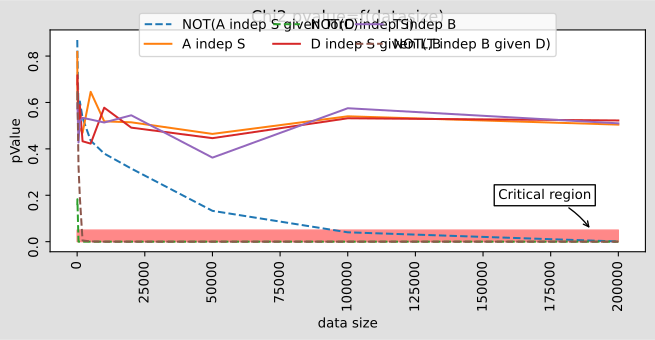
Testing d-separations using G2 in the database
Section titled “Testing d-separations using G2 in the database”def testIndepFromG2(learner, var1, var2, kno=[]): """ Just prints the resultat of the G2 """ stat, pvalue = learner.G2(var1, var2, kno) if len(kno) == 0: print("From G2 tests, is '{}' indep from '{}' ==> {}".format(var1, var2, isIndep(pvalue))) else: print("From G2 tests, is '{}' indep from '{}' given {} : {}".format(var1, var2, kno, isIndep(pvalue)))
learner = gum.BNLearner("out/sample_score.csv")
testIndepFromG2(learner, "visit_to_Asia", "smoking")testIndepFromG2(learner, "visit_to_Asia", "smoking", ["tuberculos_or_cancer"])testIndepFromG2(learner, "visit_to_Asia", "smoking", ["positive_XraY"])testIndepFromG2(learner, "dyspnoea", "smoking")testIndepFromG2(learner, "dyspnoea", "smoking", ["lung_cancer", "bronchitis"])From G2 tests, is 'visit_to_Asia' indep from 'smoking' ==> TrueFrom G2 tests, is 'visit_to_Asia' indep from 'smoking' given ['tuberculos_or_cancer'] : FalseFrom G2 tests, is 'visit_to_Asia' indep from 'smoking' given ['positive_XraY'] : TrueFrom G2 tests, is 'dyspnoea' indep from 'smoking' ==> FalseFrom G2 tests, is 'dyspnoea' indep from 'smoking' given ['lung_cancer', 'bronchitis'] : TrueEvolution of G2 p-values w.r.t the size of the database (in Asia)
Section titled “Evolution of G2 p-values w.r.t the size of the database (in Asia)”def consolidationIndepFromG2(bn, size, lindep, nbr=20): """ Using $nbr$ generated databases of size $size$ from the bn $bn$, consolidate the p-value for a list $lindep$ of conditional independence to test.
return the list of consolidated pValues """ pvalue_cumul = [0.0] * len(lindep) for i in range(nbr): gum.generateSample(bn, size, "out/sample_chi2.csv", False) learner = gum.BNLearner("out/sample_chi2.csv") for i, (var1, var2, kno) in enumerate(lindep): stat, pvalue = learner.G2(var1, var2, kno) pvalue_cumul[i] += pvalue return [p / nbr for p in pvalue_cumul]
sizes = [50, 100, 500, 1000, 2000, 5000, 10000, 20000, 50000, 100000, 200000]pvalues1, pvalues2, pvalues3, pvalues4, pvalues5, pvalues6 = zip( *[ consolidationIndepFromG2( bn, siz, [ ("visit_to_Asia", "smoking", ["tuberculos_or_cancer"]), ("visit_to_Asia", "smoking", []), ("dyspnoea", "smoking", []), ("dyspnoea", "smoking", ["lung_cancer", "bronchitis"]), ("tuberculosis", "bronchitis", []), ("tuberculosis", "bronchitis", ["dyspnoea"]), ], ) for siz in sizes ])fig = figure(figsize=FIGSIZE)ax = fig.add_subplot(1, 1, 1)
ax.plot(sizes, pvalues1, label="NOT(A indep S given TorC)", linestyle="dashed")ax.plot(sizes, pvalues2, label="A indep S")ax.plot(sizes, pvalues3, label="NOT(D indep S)", linestyle="dashed")ax.plot(sizes, pvalues4, label="D indep S given L,B")ax.plot(sizes, pvalues5, label="T indep B")ax.plot(sizes, pvalues6, label="NOT(T indep B given D)", linestyle="dashed")
ax.tick_params(rotation=90)ax.set_xlabel("data size")ax.set_ylabel("pValue")ax.legend(bbox_to_anchor=(0.15, 0.83, 0.7, 0.102), loc=3, ncol=2, mode="expand", borderaxespad=0.0)
rect = patches.Rectangle((0, 0), max(sizes), 0.05, linewidth=1, edgecolor="#FF8888", facecolor="#FF8888")ax.add_patch(rect)ax.annotate( "Critical region", xytext=(190000, 0.2), xy=(190000, 0.05), ha="right", va="center", arrowprops=dict(arrowstyle="->", connectionstyle="arc3,rad=-0.15"), bbox=dict(boxstyle="square", fc="w"),)
ax.set_title("G2 pvalue=f(datasize)")gnb.flow.add(fig)gnb.flow.add(gnb.getBN(gum.fastBN("A->T->TorC->X;S->C->TorC->D<-B<-S")))gnb.flow.new_line()

Conditional joint log-likelihood
Section titled “Conditional joint log-likelihood”With BNLearner, you can also check the joint (condtional) log-likelihood in the base
bnsiz = 10000gum.generateSample(bn, siz, "out/sample_score.csv", False)learner = gum.BNLearner("out/sample_score.csv")
def affLL(learner, s1, s2=[]): if len(s2) == 0: print("{} : {}".format(s1, learner.logLikelihood(s1))) else: print("{}|{} : {}".format(s1, s2, learner.logLikelihood(s1, s2)))
def dsepByLL(learner, x, y, z): # is X indep of Y given Z ? lxy_z = learner.logLikelihood([x, y], [z]) lx_z = learner.logLikelihood([x], [z]) ly_z = learner.logLikelihood([y], [z]) print("{} indep {} given {} : {}".format(x, y, z, lxy_z - lx_z - ly_z))
print("Condional Joint LogLikelihood")affLL(learner, ["lung_cancer", "bronchitis", "smoking"])affLL(learner, ["smoking"])affLL(learner, ["lung_cancer", "bronchitis"], ["smoking"])
print("--------------")print("LL indep test")dsepByLL(learner, "lung_cancer", "bronchitis", "smoking")dsepByLL(learner, "tuberculos_or_cancer", "bronchitis", "dyspnoea")Condional Joint LogLikelihood['lung_cancer', 'bronchitis', 'smoking'] : -21956.8056247304['smoking'] : -9998.244457465393['lung_cancer', 'bronchitis']|['smoking'] : -11958.561167265008--------------LL indep testlung_cancer indep bronchitis given smoking : 0.2889660971286503tuberculos_or_cancer indep bronchitis given dyspnoea : 118.26658280103402Evolution of conditional log-likelihood w.r.t the size of the database (in Asia)
Section titled “Evolution of conditional log-likelihood w.r.t the size of the database (in Asia)”def consolidationIndepFromLL(bn, size, lindep, nbr=20): """ Using $nbr$ generated databases of size $size$ from the bn $bn$, consolidate the logLikelihoos for a list $lindep$ of conditional independence to test.
return the list of consolidated pValues """ LL_cumul = [0.0] * len(lindep) for i in range(nbr): gum.generateSample(bn, size, "out/sample_score.csv", False) learner = gum.BNLearner("out/sample_score.csv") for i, (var1, var2, kno) in enumerate(lindep): LL12 = learner.logLikelihood([var1, var2], kno) LL1 = learner.logLikelihood([var1], kno) LL2 = learner.logLikelihood([var2], kno) LL_cumul[i] += (LL12 - LL1 - LL2) / size return [p / nbr for p in LL_cumul]
sizes = [50, 100, 500, 1000, 2000, 5000, 10000, 20000, 50000, 100000, 200000]LL1, LL2, LL3, LL4, LL5, LL6 = zip( *[ consolidationIndepFromLL( bn, siz, [ ("visit_to_Asia", "smoking", ["tuberculos_or_cancer"]), ("visit_to_Asia", "smoking", []), ("dyspnoea", "smoking", []), ("dyspnoea", "smoking", ["lung_cancer", "bronchitis"]), ("tuberculosis", "bronchitis", []), ("tuberculosis", "bronchitis", ["dyspnoea"]), ], ) for siz in sizes ])%matplotlib inlinefrom pylab import *import matplotlib.patches as patches
fig = figure(figsize=FIGSIZE)ax = fig.add_subplot(1, 1, 1)
ax.plot(sizes, LL1, label="NOT(A indep S given TorC)", linestyle="dashed")ax.plot(sizes, LL2, label="A indep S")ax.plot(sizes, LL3, label="NOT(D indep S)", linestyle="dashed")ax.plot(sizes, LL4, label="D indep S given C,B")ax.plot(sizes, LL5, label="T indep B")ax.plot(sizes, LL6, label="NOT(T indep B given D)", linestyle="dashed")ax.tick_params(rotation=90)ax.set_xlabel("data size")ax.set_ylabel("LL/size")ax.semilogy()ax.legend(bbox_to_anchor=(0.15, 0.8, 0.8, 0.102), loc=3, ncol=3, mode="expand", borderaxespad=0.0)
ax.set_title("logLikelihood=f(datasize)")gnb.flow.add(fig)gnb.flow.add(gnb.getBN(gum.fastBN("A->T->TorC->X;S->C->TorC->D<-B<-S")))gnb.flow.new_line();Comparing the scores
Section titled “Comparing the scores”gnb.flow.display()