Comparing classifiers (including Bayesian networks) with scikit-learn
In this notebook, we use the skbn module to insert bayesian networks into some examples from the scikit-learn documentation (that we refer).
 |  |  |
import pyagrum as gumimport pyagrum.lib.notebook as gnbfrom pyagrum.skbn import BNClassifier, createBNClassifierBinary classifiers
Section titled “Binary classifiers”## From <https://scikit-learn.org/stable/auto_examples/classification/plot_classifier_comparison.html)>## Code source: Gael Varoquaux Andreas Muller## Modified for documentation by Jaques Grobler## License: BSD 3 clauseimport numpy as np
import matplotlib.pyplot as pltimport matplotlib.patheffects as pe
from matplotlib.colors import ListedColormapfrom sklearn.model_selection import train_test_splitfrom sklearn.preprocessing import StandardScalerfrom sklearn.datasets import make_moons, make_circles, make_classificationfrom sklearn.neural_network import MLPClassifierfrom sklearn.neighbors import KNeighborsClassifierfrom sklearn.svm import SVCfrom sklearn.gaussian_process import GaussianProcessClassifierfrom sklearn.gaussian_process.kernels import RBFfrom sklearn.tree import DecisionTreeClassifierfrom sklearn.ensemble import RandomForestClassifier, AdaBoostClassifierfrom sklearn.naive_bayes import GaussianNBfrom sklearn.discriminant_analysis import QuadraticDiscriminantAnalysis## the dataX, y = make_classification(n_features=2, n_redundant=0, n_informative=2, random_state=1, n_clusters_per_class=1)rng = np.random.RandomState(2)X += 2 * rng.uniform(size=X.shape)linearly_separable = (X, y)
datasets = [ make_moons(noise=0.3, random_state=0), make_circles(noise=0.2, factor=0.5, random_state=1), linearly_separable,]datasets_name = ["Moons ", "Circle", "LinSep"]from ipywidgets import IntProgress
def showComparison(names, classifiers, datasets, datasets_name): # the results bnres = [None] * len(datasets_name) h = 0.02 # step size in the mesh fs = 6
figure = plt.figure(figsize=(12, 4)) i = 1 # iterate over datasets for ds_cnt, ds in enumerate(datasets): print(datasets_name[ds_cnt] + " : ", end="") # preprocess dataset, split into training and test part X, y = ds X = StandardScaler().fit_transform(X) X_train, X_test, y_train, y_test = train_test_split(X, y, test_size=0.4, random_state=42)
x_min, x_max = X[:, 0].min() - 0.5, X[:, 0].max() + 0.5 y_min, y_max = X[:, 1].min() - 0.5, X[:, 1].max() + 0.5 xx, yy = np.meshgrid(np.arange(x_min, x_max, h), np.arange(y_min, y_max, h))
# just plot the dataset first cm = plt.cm.RdBu cm_bright = ListedColormap(["#FF0000", "#0000FF"]) ax = plt.subplot(len(datasets), len(classifiers) + 1, i) if ds_cnt == 0: ax.set_title("Input data", fontsize=fs) ax.set_ylabel(datasets_name[ds_cnt])
# Plot the training points ax.scatter(X_train[:, 0], X_train[:, 1], c=y_train, cmap=cm_bright, edgecolors="k", marker=".") # Plot the testing points ax.scatter(X_test[:, 0], X_test[:, 1], c=y_test, cmap=cm_bright, alpha=0.6, edgecolors="k", marker=".") ax.set_xlim(xx.min(), xx.max()) ax.set_ylim(yy.min(), yy.max()) ax.set_xticks(()) ax.set_yticks(()) i += 1
# iterate over classifiers f = IntProgress(min=0, max=len(names)) display(f) for name, clf in zip(names, classifiers): # print(".", end="", flush=True) f.value += 1 ax = plt.subplot(len(datasets), len(classifiers) + 1, i) clf.fit(X_train, y_train) score = clf.score(X_test, y_test)
# Plot the decision boundary. For that, we will assign a color to each # point in the mesh [x_min, x_max]x[y_min, y_max]. if hasattr(clf, "decision_function"): Z = clf.decision_function(np.c_[xx.ravel(), yy.ravel()]) else: Z = clf.predict_proba(np.c_[xx.ravel(), yy.ravel()])[:, 1]
# Put the result into a color plot Z = Z.reshape(xx.shape) ax.contourf(xx, yy, Z, cmap=cm, alpha=0.7)
# Plot the training points # ax.scatter(X_train[:, 0], X_train[:, 1], c=y_train, cmap=cm_bright, # edgecolors='k', alpha=0.2,marker='.') # Plot the testing points ax.scatter(X_test[:, 0], X_test[:, 1], c=y_test, cmap=cm_bright, edgecolors="k", marker=".")
ax.set_xlim(xx.min(), xx.max()) ax.set_ylim(yy.min(), yy.max()) ax.set_xticks(()) ax.set_yticks(()) if ds_cnt == 0: ax.set_title(name, fontsize=fs) ax.text( xx.max() - 0.3, yy.min() + 0.3, ("%.2f" % score).lstrip("0"), size=12, horizontalalignment="right", color="white", path_effects=[pe.withStroke(linewidth=2, foreground="black")], ) i += 1 bnres[ds_cnt] = gum.BayesNet(classifiers[-1].bn_) print()
plt.tight_layout() plt.show()
return bnres## the classifiersnames = [ "Nearest Neighbors", "Linear SVM", "RBF SVM", "Gaussian Process", "Decision Tree", "Random Forest", "Neural Net", "AdaBoost", "Naive Bayes", "QDA", "BNClassifier",]classifiers = [ KNeighborsClassifier(3), SVC(kernel="linear", C=0.025), SVC(gamma=2, C=1), GaussianProcessClassifier(1.0 * RBF(1.0)), DecisionTreeClassifier(max_depth=5), RandomForestClassifier(max_depth=5, n_estimators=10, max_features=1), MLPClassifier(alpha=1, max_iter=1000), AdaBoostClassifier(), GaussianNB(), QuadraticDiscriminantAnalysis(), createBNClassifier( learningMethod="MIIC", prior="Smoothing", priorWeight=0.01, discretizationNbBins=5, discretizationStrategy="kmeans", # 'kmeans', 'uniform', 'quantile', 'NML', 'MDLP', 'CAIM', 'NoDiscretization' usePR=False, ),]
bnres = showComparison(names, classifiers, datasets, datasets_name)Moons :
IntProgress(value=0, max=11)
Circle :
IntProgress(value=0, max=11)
LinSep :
IntProgress(value=0, max=11)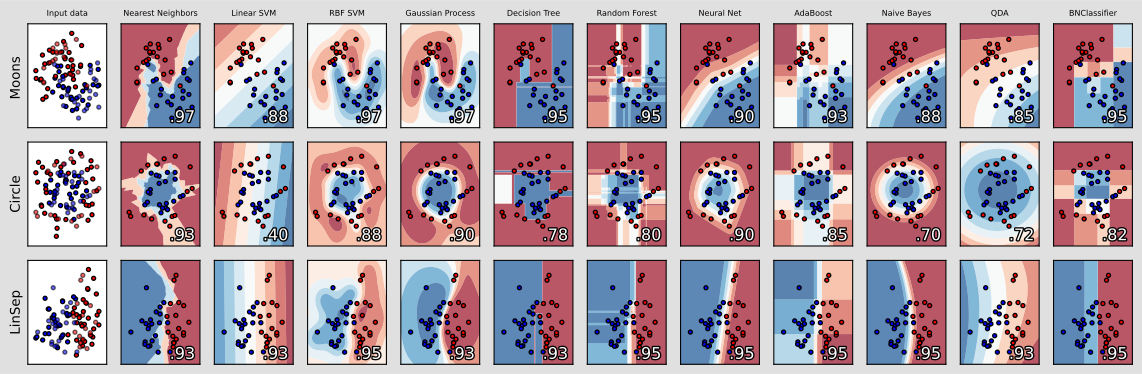
The three BNs learned for each task:
gnb.sideBySide(*bnres, captions=datasets_name)Note that, for LinSep, the BNClassifier has correctly learned that and are independent (no need of to predict ). is not a relevant feature for this classification.
A zoom of one of this BN classifiers
Section titled “A zoom of one of this BN classifiers”h = 0.2ds = make_moons(noise=0.3, random_state=0)X, y = dsX = StandardScaler().fit_transform(X)X_train, X_test, y_train, y_test = train_test_split(X, y, test_size=0.4, random_state=42)x_min, x_max = X[:, 0].min() - 0.5, X[:, 0].max() + 0.5y_min, y_max = X[:, 1].min() - 0.5, X[:, 1].max() + 0.5xx, yy = np.meshgrid(np.arange(x_min, x_max, h), np.arange(y_min, y_max, h))clf = createBNClassifier( learningMethod="MIIC", prior="Smoothing", priorWeight=0.01, discretizationNbBins=5, discretizationStrategy="kmeans", usePR=False,)
clf.fit(X_train, y_train)score = clf.score(X_test, y_test)
Z = clf.predict_proba(np.c_[xx.ravel(), yy.ravel()])[:, 1]clf.bn_
Z = Z.reshape(xx.shape)
ax = plt.subplot(1, 1, 1)
ax.set_xlim(xx.min(), xx.max())ax.set_ylim(yy.min(), yy.max())ax.set_xticks(())ax.set_yticks(())
ax.scatter(X_test[:, 0], X_test[:, 1], c=y_test, alpha=0.6, edgecolors="k", marker=".")ax.contourf(xx, yy, Z, alpha=0.7)
ax.text( xx.max() - 0.3, yy.min() + 0.3, ("%.2f" % score).lstrip("0"), size=12, horizontalalignment="right", color="white", path_effects=[pe.withStroke(linewidth=2, foreground="black")],);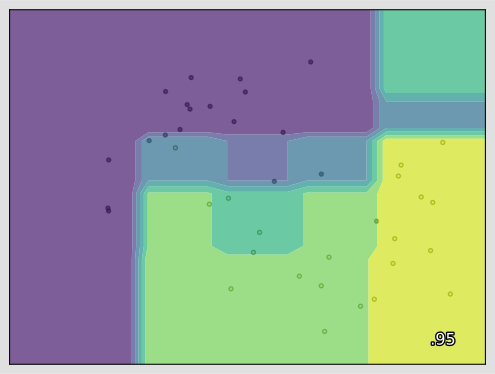
n-ary classifiers on IRIS dataset
Section titled “n-ary classifiers on IRIS dataset”## From <https://scikit-learn.org/stable/auto_examples/classification/plot_classification_probability.html#sphx-glr-auto-examples-classification-plot-classification-probability-py>## Author: Alexandre Gramfort <alexandre.gramfort@inria.fr>## License: BSD 3 clauseimport matplotlib.pyplot as pltimport numpy as np
from sklearn.metrics import accuracy_scorefrom sklearn.linear_model import LogisticRegressionfrom sklearn.svm import SVCfrom sklearn.gaussian_process import GaussianProcessClassifierfrom sklearn.gaussian_process.kernels import RBFfrom sklearn import datasets
iris = datasets.load_iris()X = iris.data[:, 0:2] # we only take the first two features for visualizationy = iris.target
n_features = X.shape[1]
C = 10kernel = 1.0 * RBF([1.0, 1.0]) # for GPC
## Create different classifiers.classifiers = { "L1 logistic": LogisticRegression(C=C, l1_ratio=1, solver="saga", max_iter=10000), "L2 logistic (Multinomial)": LogisticRegression(C=C, l1_ratio=0, solver="saga", max_iter=10000), "L2 logistic (OvR)": LogisticRegression(C=C, l1_ratio=0, solver="saga", max_iter=10000), "Linear SVC": SVC(kernel="linear", C=C, probability=True, random_state=0), # 'GPC': GaussianProcessClassifier(kernel), # too long "BN": createBNClassifier( learningMethod="MIIC", prior="Smoothing", priorWeight=1, discretizationNbBins=9, discretizationStrategy="quantile", discretizationThreshold=10, ),}
n_classifiers = len(classifiers)
plt.figure(figsize=(3 * 2, n_classifiers * 2))plt.subplots_adjust(bottom=0.2, top=0.95)
xx = np.linspace(3, 9, 100)yy = np.linspace(1, 5, 100).Txx, yy = np.meshgrid(xx, yy)Xfull = np.c_[xx.ravel(), yy.ravel()]
for index, (name, classifier) in enumerate(classifiers.items()): classifier.fit(X, y)
y_pred = classifier.predict(X) accuracy = accuracy_score(y, y_pred) print("Accuracy (train) for %s: %0.1f%% " % (name, accuracy * 100))
# View probabilities: probas = classifier.predict_proba(Xfull) n_classes = np.unique(y_pred).size for k in range(n_classes): plt.subplot(n_classifiers, n_classes, index * n_classes + k + 1) plt.title("Class %d" % k) if k == 0: plt.ylabel(name) imshow_handle = plt.imshow(probas[:, k].reshape((100, 100)), extent=(3, 9, 1, 5), origin="lower") plt.xticks(()) plt.yticks(()) idx = y_pred == k if idx.any(): plt.scatter(X[idx, 0], X[idx, 1], marker="o", c="w", edgecolor="k")
ax = plt.axes([0.15, 0.04, 0.7, 0.05])plt.title("Probability")plt.colorbar(imshow_handle, cax=ax, orientation="horizontal")
plt.show()Accuracy (train) for L1 logistic: 82.7%Accuracy (train) for L2 logistic (Multinomial): 82.7%Accuracy (train) for L2 logistic (OvR): 82.7%Accuracy (train) for Linear SVC: 82.0%Accuracy (train) for BN: 83.3%
/Users/phw/.virtualenvs/devAgrum/lib/python3.14/site-packages/sklearn/svm/_base.py:236: FutureWarning: The `probability` parameter was deprecated in 1.9 and will be removed in version 1.11. Use `CalibratedClassifierCV(SVC(), ensemble=False)` instead of `SVC(probability=True)` warnings.warn(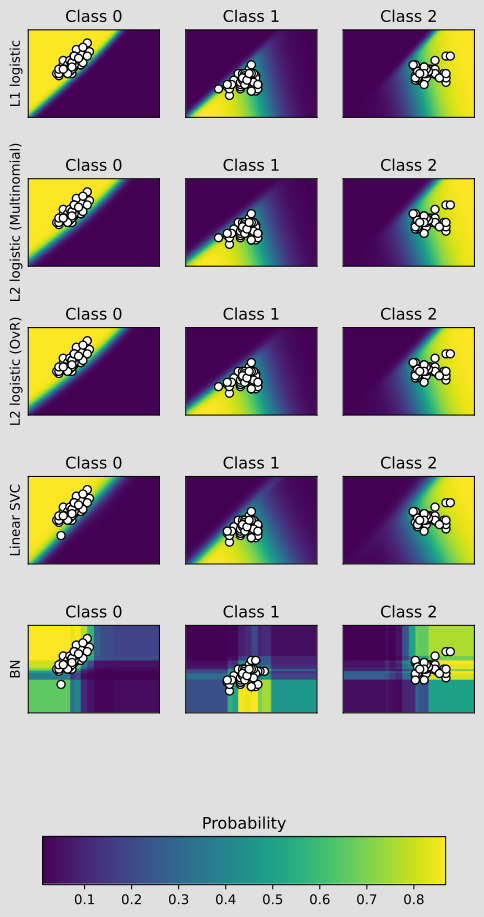
So the BNClassifier gives the ‘best’ accuracy (even if discretized). Moreover, once again, it propose a structural representation of the classification mechanism.
classifiers["BN"].bn_Recognizing hand-written digits with Bayesian Networks
Section titled “Recognizing hand-written digits with Bayesian Networks”## From <https://scikit-learn.org/stable/auto_examples/classification/plot_digits_classification.html#sphx-glr-auto-examples-classification-plot-digits-classification-py>## Author: Gael Varoquaux <gael dot varoquaux at normalesup dot org>## License: BSD 3 clause## Standard scientific Python importsimport matplotlib.pyplot as plt
## Import datasets, classifiers and performance metricsfrom sklearn import datasets, metricsfrom sklearn.model_selection import train_test_split
digits = datasets.load_digits()
_, axes = plt.subplots(nrows=1, ncols=4, figsize=(10, 3))for ax, image, label in zip(axes, digits.images, digits.target): ax.set_axis_off() ax.imshow(image, cmap=plt.cm.gray_r, interpolation="nearest") ax.set_title("Training: %i" % label)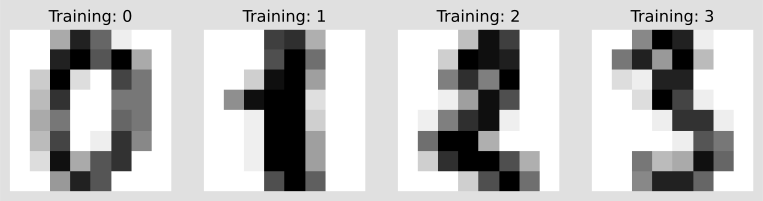
## flatten the imagesn_samples = len(digits.images)data = digits.images.reshape((n_samples, -1)).astype(int)
## Create a classifier: a support vector classifier## clf = svm.SVC(gamma=0.001)clf = createBNClassifier(  learningMethod="MIIC",  prior="Smoothing",  priorWeight=1,  discretizationNbBins=3,  discretizationStrategy="kmeans",  discretizationThreshold=10,)
## Split data into 50% train and 50% test subsetsX_train, X_test, y_train, y_test = train_test_split(data, digits.target, test_size=0.5, shuffle=False)
## Learn the digits on the train subsetclf.fit(X_train, y_train)
## Predict the value of the digit on the test subsetpredicted = clf.predict(X_test)
_, axes = plt.subplots(nrows=1, ncols=4, figsize=(10, 3))for ax, image, prediction in zip(axes, X_test, predicted):  ax.set_axis_off()  image = image.reshape(8, 8)  ax.imshow(image, cmap=plt.cm.gray_r, interpolation="nearest")  ax.set_title(f"Prediction: {int(prediction)}")
cm = metrics.confusion_matrix(y_test, predicted)disp = metrics.ConfusionMatrixDisplay(confusion_matrix=cm)disp.plot()
plt.show()
print(f"Classification report for classifier {clf}:\n{metrics.classification_report(y_test, predicted)}\n")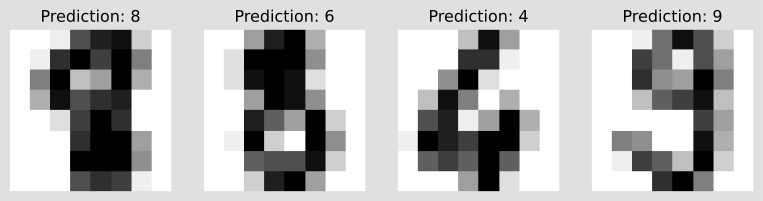
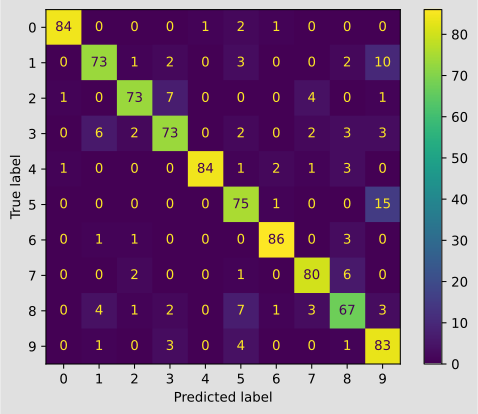
Classification report for classifier BNClassifier(prior='Smoothing',             type_processor=<pyagrum.lib.discreteTypeProcessor.DiscreteTypeProcessor object at 0x116a82f90>):              precision    recall  f1-score   support
           0       0.98      0.95      0.97        88           1       0.86      0.80      0.83        91           2       0.91      0.85      0.88        86           3       0.84      0.80      0.82        91           4       0.99      0.91      0.95        92           5       0.79      0.82      0.81        91           6       0.95      0.95      0.95        91           7       0.89      0.90      0.89        89           8       0.79      0.76      0.77        88           9       0.72      0.90      0.80        92
    accuracy                           0.87       899   macro avg       0.87      0.87      0.87       899weighted avg       0.87      0.87      0.87       899
Focus on the pixels needed for the classification
Section titled “Focus on the pixels needed for the classification”As always, using BNClassifier make us learn a bit more about the structure of the problem.
gnb.show(clf.bn_, size="13!")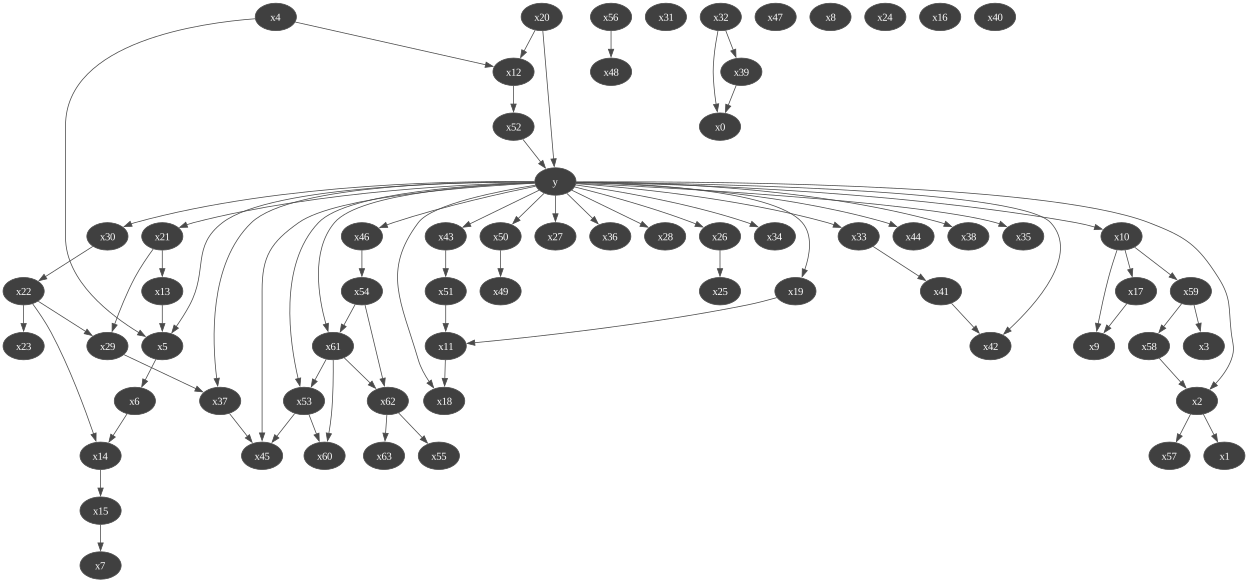
Then, once again, the Markov Blanket gives us the relevant features (here the pixels)
print("Markov blanket of the classifier:")gnb.show(clf.MarkovBlanket_, size="14!")print(f"Number of pixels used for classification : {clf.MarkovBlanket_.size() - 1}/64")Markov blanket of the classifier:
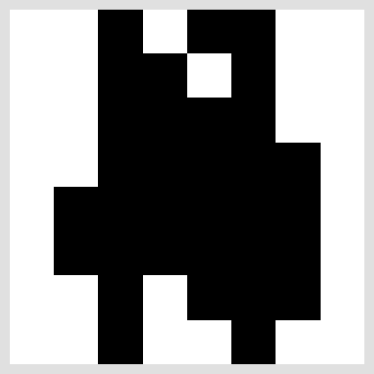
Number of pixels used for classification : 33/64It appears that many pixels are not relevant for this classification.
## Visualization of the pixels of the Markov Blanket
fig, ax = plt.subplots()ax.set_axis_off()relevant_pixels = set([int(x[1:]) for x in clf.MarkovBlanket_.names() if x != "y"])ax.imshow(np.array([1 if i in relevant_pixels else 0 for i in range(64)]).reshape(8, 8), cmap=plt.cm.gray_r)plt.show()