


Multinomial Simpson Paradox
this notebook shows a model for a multinomial Simpson paradox.
 |  |  |
import pandas as pd
import pyagrum.causal_model as gumimport pyagrum.lib.notebook as gnb
Building the models
Section titled “Building the models”## building a model including a Simpson's paradoximport scipy.stats as stats
bn = gum.fastBN("A[0,90]->B[0:40:200]<-C[0,5]->A")
bn.cpt("C").fillFromDistribution(stats.uniform, loc=0, scale=5)bn.cpt("A").fillFromDistribution(stats.uniform, loc="C*12", scale=30)bn.cpt("B").fillFromDistribution(stats.norm, loc="5+C*4-int(A/8)", scale=3);As a site note we are dealing here with quite large models already :
bn.memoryFootprint()878016help(bn.memoryFootprint)Help on method memoryFootprint in module pyagrum.pyagrumcpp:
memoryFootprint() -> int method of pyagrum.pyagrumcpp.BayesNet instance Returns the memory footprint in bytes of the Bayesian network.
Returns ------- int the memory footprint in bytes of the Bayesian network# generating a CSV, taking this model as the causal one.gum.generateSample(bn, 400, "out/sample.csv", with_labels=False)df = pd.read_csv("out/sample.csv")df.plot.scatter(x="A", y="B", c="C", colormap="tab20");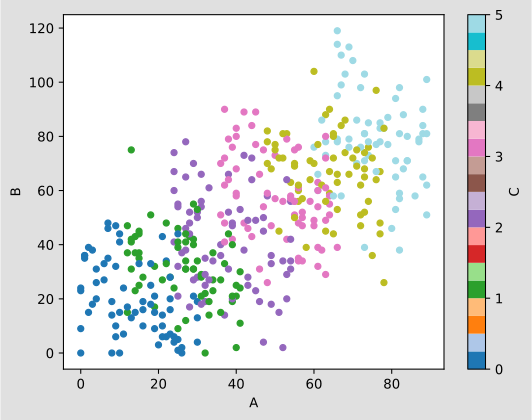
cm = gum.CausalModel(bn)_, p, _ = gum.causalImpact(cm, on="B", doing="A")## building an Markov-equivalent model, generating a CSV, taking this model as the causal one.bn2 = gum.BayesNet(bn)bn2.reverseArc("C", "A")bn2gum.generateSample(bn2, 400, "out/sample2.csv", with_labels=False)df2 = pd.read_csv("out/sample2.csv")
cm2 = gum.CausalModel(bn2)_, p2, _ = gum.causalImpact(cm2, on="B", doing="A")The observationnal model and its paradoxal structure (exactly the same with the second Markov-equivalent model)
Section titled “The observationnal model and its paradoxal structure (exactly the same with the second Markov-equivalent model)”gnb.flow.row( gnb.getBN(bn), df.plot.scatter(x="A", y="B"), df.plot.scatter(x="A", y="B", c="C", colormap="tab20"), captions=["the observationnal model", "the trend is increasing", "the trend is decreasing for any value for C !"],)gnb.flow.row( gnb.getBN(bn2), df2.plot.scatter(x="A", y="B"), df2.plot.scatter(x="A", y="B", c="C", colormap="tab20"), captions=["the Markov-equivalent model", "the trend is increasing", "the trend is decreasing for any value for C !"],)gnb.flow.display()

The paradox is revealed in the trend of the inferred means : the means are increasing with the value of except for any value of …
Section titled “The paradox is revealed in the trend of the inferred means : the means are increasing with the value of AA except for any value of CC …”gum.config["notebook", "histogram_epsilon"] = 0.001gum.config["notebook", "histogram_discretized_scale"] = 0.4for a in [10, 20, 30]: gnb.flow.add_html(gnb.getPosterior(bn, target="B", evs={"A": a}), f"$P(B|A={a})$")gnb.flow.new_line()for a in [10, 20, 30]: gnb.flow.add_html(gnb.getPosterior(bn, target="B", evs={"A": a, "C": 0}), f"P(B | $A={a},C=0)$")gnb.flow.new_line()for a in [10, 20, 30]: gnb.flow.add_html(gnb.getPosterior(bn, target="B", evs={"A": a, "C": 2}), f"P(B | $A={a},C=2$)")gnb.flow.new_line()for a in [10, 20, 30]: gnb.flow.add_html(gnb.getPosterior(bn, target="B", evs={"A": a, "C": 4}), f"P(B | $A={a},C=4$)")gnb.flow.display()


Now that the paradoxal structure is understood and the paradox is revealed, will we choose to observe (or not) before deciding to increase or decrease (with the goal to maximize ) ?
Section titled “Now that the paradoxal structure is understood and the paradox is revealed, will we choose to observe CC (or not) before deciding to increase or decrease AA (with the goal to maximize BB) ?”Of course, it depends on the causal structure of the problem !
If is cause for , observing really gives a new information about .
Section titled “If CC is cause for AA, observing CC really gives a new information about BB.”gnb.flow.add_html(gnb.getCausalModel(cm), "the first causal model")gnb.flow.new_line()for v in [10, 20, 30]: gnb.flow.add_html(gnb.getProba(p.extract({"A": v})), f"Doing $A={v}$")gnb.flow.display()


if is cause for , observing may lead to misinterpretations about the causal role of .
Section titled “if AA is cause for CC, observing CC may lead to misinterpretations about the causal role of AA.”gnb.flow.add_html(gnb.getCausalModel(cm2), "the second causal model")gnb.flow.new_line()for v in [10, 20, 30]: gnb.flow.add_html(gnb.getProba(p2.extract({"A": v})), f"Doing $A={v}$")gnb.flow.display()