


Bayesian Network Mixture (gbnm) model
 |  |  |
BNMixture represents a collection of ponderated BNs on the same domain (i.e. the same variables). Two main use can be found to such an object that implies two different classes :
BNMixture: The goal is really to represent a mixture in the form : withBootstrapMixture: This mixture represents a collection of bootstrapped BNs learnerd from a single database. The goal here is to infere statitics on the learned BN (belief in a specific arc, confidence intervall for posterior, etc.)
BNMixture Model
Section titled “BNMixture Model”Both inherit a mother class IMixture, most functions are the same, the main difference is the purpose. For instance, in the two classes, there is a reference BN which has not the same semantic : in a BNMixture, it is just the first added BN; in the BootstrapMixture, the reference is not part of the collection and represent the BN using the whole database.
| BNMixture | BootstrapMixture | |
|---|---|---|
| modify reference BN | Yes(but name) | No |
| init parameters | None | Reference BN |
| can contain a BN with same name as ref BN | No | No |
Note that the weights are not normalized automatically. The normalization is done lazily when necesssary or when asked.
Inference
- IMixtureInference : Interface.
- BNMixtureInference : Compute inference as a weighted mean of all BNs inference.
- BootstrapMixtureInference : Compute inference of the reference BN. The other BNs are used as a confidence indicator for learned parameters.
Learning
To understand the necessity of having these 2 objects, let’s illustrate how we wish to use them.
- IMixtureLearner : Interface.
- BNMLearner : We start with databases and weights (one for each). Each database allows to learn a BN with a given weight. We fill the Mixture with them.
- BNMBootstrapLearner : We start with one database. From this real sample, we learn the reference BN. Then we generate other databases using bootstrap sampling method. They all have the same weight when added to the Mixture.
If a BN to add has the same structure and parameters as another one already present in the Mixture, we sum the weights and keep the BN already present.
class BNMixture
Section titled “class BNMixture”Stores many BNs. The first BN to be added is the default reference BN. Method updateRef changes the reference BN (the one with max weight).
Creating a BNMixture (init, add)
Section titled “Creating a BNMixture (init, add)”import pyagrum as gumimport pyagrum.bnmixture as gbnm
import pyagrum.bnmixture.notebook as bnmnbimport pyagrum.lib.notebook as gnb
bn0 = gum.fastBN("A->C<-B")bn1 = gum.BayesNet(bn0)bn2 = gum.BayesNet(bn0)bn1.addArc("A", "B")bn2.addArc("B", "A")bn1.generateCPTs() # random CPTs for BN1bn2.generateCPTs() # random CPTs for BN2
bnm = gbnm.BNMixture()bnm.add("bn0", bn0, w=1.0)bnm.add("bn1", bn1, w=2.0)bnm.add("bn2", bn2, w=3.0)
print(bnm)(reference BN : refBN), (bn0, w=1.0), (bn1, w=2.0), (bn2, w=3.0)bn3 = gum.BayesNet(bn2)bnm.add("bn3", bn3, w=1.5)print(bnm)(reference BN : refBN), (bn0, w=1.0), (bn1, w=2.0), (bn2, w=4.5)Other functions
Section titled “Other functions”(setWeight, weights, isNormalized, normalize, isValid, zeroBNs, existsArcs, variable, names, size)
print("names : ", bnm.names())print("weights : ", bnm.weights())print("size : ", bnm.size())
bnm.setWeight("bn0", 1.1)
print("new weight of nb0 : ", bnm.weight("bn0"))print("weights after change : ", bnm.weights())
names : ['bn0', 'bn1', 'bn2']weights : {'bn0': 1.0, 'bn1': 2.0, 'bn2': 4.5}size : 3new weight of nb0 : 1.1weights after change : {'bn0': 1.1, 'bn1': 2.0, 'bn2': 4.5}print("is the BNMixture normalized (sum(weights == 1))? : ", bnm.isNormalized())bnm.normalize()print("is the BNMixture normalized? : ", bnm.isNormalized())print("weights after normalization : ", bnm.weights())print("sum = ", sum(bnm.weights().values()))is the BNMixture normalized (sum(weights == 1))? : Falseis the BNMixture normalized? : Trueweights after normalization : {'bn0': 0.14473684210526316, 'bn1': 0.2631578947368421, 'bn2': 0.5921052631578948}sum = 1.0print("is the mixture valid (not all of the weights are 0)? :", bnm.isValid())
bnm.setWeight("bn0", 0)bnm.setWeight("bn1", 0)bnm.setWeight("bn2", 0)print("is the mixture valid (not all of the weights are 0)? :", bnm.isValid())
bnm.setWeight("bn0", 1.1)print("is the mixture valid (not all of the weights are 0)? :", bnm.isValid())
print("\nBNs with weight == 0 : ", bnm.zeroBNs())is the mixture valid (not all of the weights are 0)? : Trueis the mixture valid (not all of the weights are 0)? : Falseis the mixture valid (not all of the weights are 0)? : True
BNs with weight == 0 : {'bn2', 'bn1'}print("how many arcs A->C among all BNs? :", bnm.existsArc("A", "C"))print("how many arcs A->B among all BNs? :", bnm.existsArc("A", "B"))print("how many arcs B->A among all BNs? :", bnm.existsArc("B", "A"))print("how many arcs C->B among all BNs? :", bnm.existsArc("C", "B"))how many arcs A->C among all BNs? : 3how many arcs A->B among all BNs? : 1how many arcs B->A among all BNs? : 1how many arcs C->B among all BNs? : 0bnmnb.showBNMixtureInference(bnm)print(bnm.variable("A"))A:Range([0,1])BNMixture input/output
Section titled “BNMixture input/output”gbnm.saveBNM(bnm, "out/test.bnm")
bnm2 = gbnm.loadBNM("out/test.bnm")
print(f"{bnm=}")print(f"{bnm2=}")bnm=(reference BN : refBN), (bn0, w=1.1), (bn1, w=0), (bn2, w=0)bnm2=(reference BN : refBN), (bn2, w=0), (bn1, w=0), (bn0, w=1.1)class BootstrapMixture
Section titled “class BootstrapMixture”Almost the same, the reference BN is handled differently. It cannot be updated.
bnm_boot = gbnm.BootstrapMixture("bn0", bn0)bnm_boot.add("bn1", bn1, w=1.0)bnm_boot.add("bn2", bn2, w=2.0)print(bnm_boot)(reference BN : bn0), (bn1, w=1.0), (bn2, w=2.0)Note : A BNMixture’s reference BN always has the name “refBN” but BootstrapMixture’s ref. BN can have any name when creating the object.
BNMixture Inference
Section titled “BNMixture Inference”class BNMInference (inference on BNMixture)
Section titled “class BNMInference (inference on BNMixture)”Here a posterior is the (normalized) weighted sum of all the posteriors.
bnm.setWeight("bn0", 1)bnm.setWeight("bn1", 2)bnm.setWeight("bn2", 1)
## def inModel(p,model):#    q=gum.Potential()#    for i in p.v
bnm_ie = gbnm.BNMixtureInference(bnm, engine=gum.LazyPropagation)
bnm_ie.makeInference()p = bnm_ie.posterior("C")
p0 = gum.getPosterior(bn0, target="C", evs={})p1 = gum.getPosterior(bn1, target="C", evs={})p2 = gum.getPosterior(bn2, target="C", evs={})## p1.toVarsIn(p0) create a potential identical to p1 but with the variable from bn0q = (p0 + 2 * p1.toVarsIn(bn0) + p2.toVarsIn(bn0)) / 4
gnb.sideBySide( gnb.getProba(p), gnb.getProba(p0), gnb.getProba(p1), gnb.getProba(p2), gnb.getProba(q), captions=[ "posterior(C) in the mixture", "posterior p0 in bn0", "posterior p1 in bn1", "posterior p2 in bn2", "manually : (1*p0+2*p1+1*p2)/4", ],)


bnmnb.showBNMixtureInference(bnm)class BootstrapMixtureInference (inference on BootstrapMixture)
Section titled “class BootstrapMixtureInference (inference on BootstrapMixture)”Here the posterior is the one of the reference BN. Other posteriors are used for other parameters such as quantiles, variance etc…
bnm_ie_boot = gbnm.BootstrapMixtureInference(bnm_boot)bnm_ie_boot.makeInference()p = bnm_ie_boot.posterior("C")gnb.sideBySide(p)q = bnm_ie_boot.quantiles("C")gnb.sideBySide(q[0], q[1], captions=["quantile 20%", "quantile 80%"])Uncolored since values don’t sum to 1.
Learning BNMixture Models
Section titled “Learning BNMixture Models”learning BNMixture : class BNMLearner
Section titled “learning BNMixture : class BNMLearner”Example for BNMixtures. Using a different database for each instance.
new_bn = gum.fastBN("A->C<-B")
generator = gum.BNDatabaseGenerator(new_bn)data = []weights = [1 for i in range(5)]for i in range(5):  generator.drawSamples(50000)  data.append(generator.to_pandas())
learner = gbnm.BNMLearner(weights, data, template=new_bn)learned_bnm = learner.learnBNM()
learned_bnm.updateRef()bnmnb.showMixtureGraph(learned_bnm, ref=True)print(learned_bnm)(reference BN : refBN), (bn0, w=1), (bn1, w=1), (bn2, w=1), (bn3, w=1), (bn4, w=1)learning BootstrapMixture : class BNMBootstrapLearner
Section titled “learning BootstrapMixture : class BNMBootstrapLearner”Example for BootstrapMixtures. Using one database only.
generator.drawSamples(5000)refsample = generator.to_pandas()
refsample| A | C | B | |
|---|---|---|---|
| 0 | 0 | 1 | 1 |
| 1 | 0 | 0 | 1 |
| 2 | 0 | 1 | 1 |
| 3 | 0 | 1 | 1 |
| 4 | 0 | 0 | 1 |
| ... | ... | ... | ... |
| 4995 | 0 | 1 | 0 |
| 4996 | 1 | 1 | 0 |
| 4997 | 1 | 1 | 1 |
| 4998 | 0 | 1 | 0 |
| 4999 | 1 | 1 | 1 |
5000 rows × 3 columns
boot_learner = gbnm.BNMBootstrapLearner(refsample, template=new_bn)boot_learner.useIter(6)learned_boot = boot_learner.learnBNM()bnmnb.showMixtureGraph(learned_boot, ref=True)Graphical tools
Section titled “Graphical tools”bnmnb.showMixtureGraph(learned_bnm, ref=False)bnmnb.showMixtureGraph(bnm, ref=True)bnmnb.showBNMixtureInference(learned_bnm)bnmnb.showBNMixtureInference(bnm)bnmnb.showBootstrapMixtureInference(bnm_boot, quantiles=True)Arc comparison : confidence
Section titled “Arc comparison : confidence”bnmnb.showComparison(bnm_boot, refStruct=True)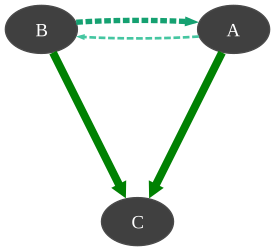
One of the features of BNMs is the possibility to graphicaly compare the arcs of all the BNs in a mixture. For each arc there is a confidence value between 0 and 1 describing how much an arc appears in the gbnm, this value is a weighted mean, using the weight of each BN. Arcs that appear in the reference BN are filled while arcs appearing in others BNs but not in the reference one are dashed. The more confidence we have in an arc, the darker its color gets.
gnb.flow.clear()gnb.flow.add(bnmnb.getArcsComparison(bnm_boot, refStruct=True))gnb.flow.add(bnmnb.arcsCompLegend())gnb.flow.add(bnmnb.getArcsComparison(learned_bnm, refStruct=True))gnb.flow.display()

gnb.flow.clear()gnb.flow.add(bnmnb.getArcsComparison(bnm_boot, refStruct=False))gnb.flow.add(bnmnb.arcsCompLegend())gnb.flow.add(bnmnb.getArcsComparison(learned_bnm, refStruct=False))gnb.flow.display()