


Kullback-Leibler for Bayesian networks
 |  |  |
from pylab import *import pyagrum and pyagrum.lib.notebook (for … notebooks :-) )
Section titled “import pyagrum and pyagrum.lib.notebook (for … notebooks :-) )”import pyagrum as gumimport pyagrum.lib.notebook as gnbCreate a first BN : bn
Section titled “Create a first BN : bn”bn = gum.loadBN("res/asia.bgum")## randomly re-generate parameters for every Conditional Probability Tablebn.generateCPTs()bnCreate a second BN : bn2
Section titled “Create a second BN : bn2”bn2 = gum.loadBN("res/asia.bgum")bn2.generateCPTs()bn2bn vs bn2 : different parameters
Section titled “bn vs bn2 : different parameters”gnb.flow.row(bn.cpt(3), bn2.cpt(3), captions=["a CPT in bn", "same CPT in bn2 (with different parameters)"])|
|
| |
|---|---|---|
| 0.5152 | 0.4848 | |
| 0.9425 | 0.0575 | |
|
|
| |
|---|---|---|
| 0.4660 | 0.5340 | |
| 0.0516 | 0.9484 | |
Exact and (Gibbs) approximated KL-divergence
Section titled “Exact and (Gibbs) approximated KL-divergence”In order to compute KL-divergence, we just need to be sure that the 2 distributions are defined on the same domain (same variables, etc.)
Exact KL
g1 = gum.ExactBNdistance(bn, bn2)print(g1.compute()){'klPQ': 4.37153811952777, 'errorPQ': 0, 'klQP': 5.248500584257424, 'errorQP': 0, 'hellinger': 1.0227531272984967, 'bhattacharya': 0.7402639030830264, 'jensen-shannon': 0.6149194526009993}If the models are not on the same domain :
bn_different_domain = gum.loadBN("res/alarm.bgum")
## g=gum.BruteForceKL(bn,bn_different_domain) # a KL-divergence between asia and alarm ... :(### would cause# ---------------------------------------------------------------------------## OperationNotAllowed                       Traceback (most recent call last)### OperationNotAllowed: this operation is not allowed : KL : the 2 BNs are not compatible (not the same vars : visit_to_Asia?)
Gibbs-approximated KL
g = gum.GibbsBNdistance(bn, bn2)g.setVerbosity(True)g.setMaxTime(120)g.setBurnIn(5000)g.setEpsilon(1e-7)g.setPeriodSize(500)print(g.compute())print("Computed in {0} s".format(g.currentTime())){'klPQ': 4.362460376561506, 'errorPQ': 0, 'klQP': 10.856396417078104, 'errorQP': 0, 'hellinger': 1.1889769649341448, 'bhattacharya': 0.7313818510097687, 'jensen-shannon': 0.8012451054868004}
Computed in 0.762048 sprint("--")
print(g.messageApproximationScheme())print("--")
print("Temps de calcul : {0}".format(g.currentTime()))print("Nombre d'itérations : {0}".format(g.nbrIterations()))--stopped with epsilon=1e-07--Temps de calcul : 0.762048Nombre d'itérations : 200500p = plot(g.history(), "g")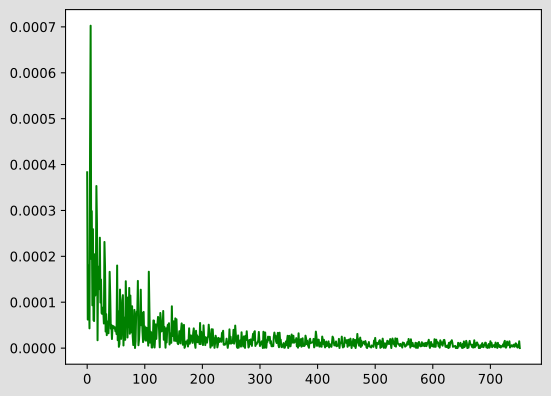
Animation of Gibbs KL
Section titled “Animation of Gibbs KL”Since it may be difficult to know what happens during approximation algorithm, pyAgrum allows to follow the iteration using animated matplotlib figure
g = gum.GibbsBNdistance(bn, bn2)g.setMaxTime(60)g.setBurnIn(500)g.setEpsilon(1e-7)g.setPeriodSize(5000)gnb.animApproximationScheme(g) # logarithmique scale for Yg.compute()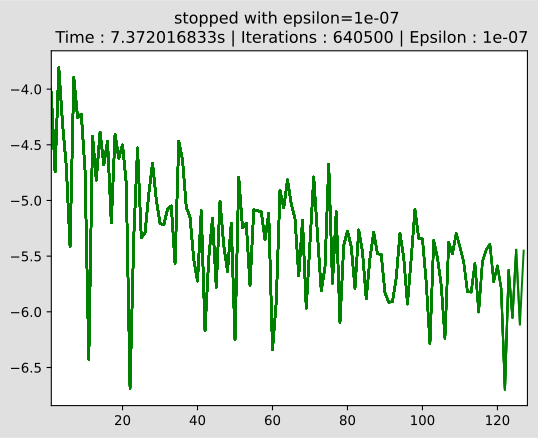
{'klPQ': 4.325022098545639, 'errorPQ': 0, 'klQP': 2.916164209116859, 'errorQP': 0, 'hellinger': 0.9389877705574012, 'bhattacharya': 0.7403193269979281, 'jensen-shannon': 0.5312845476841115}
Monte-Carlo-approximated KL
Unlike Gibbs sampling, MCBNDistance draws each sample independently (forward/topological sampling from P), with no Markov chain and therefore no burn-in.
mc = gum.MCBNDistance(bn, bn2)mc.setVerbosity(True)mc.setMaxTime(120)mc.setEpsilon(1e-7)mc.setPeriodSize(500)print(mc.compute())print("Computed in {0} s".format(mc.currentTime())){'klPQ': 4.370169255985552, 'errorPQ': 0, 'klQP': 3.1454184222656343, 'errorQP': 0, 'hellinger': 0.9521790209831562, 'bhattacharya': 0.7397710812441313, 'jensen-shannon': 0.5445506095114102}Computed in 1.599782167 sprint("--")
print(mc.messageApproximationScheme())print("--")
print("Temps de calcul : {0}".format(mc.currentTime()))print("Nombre d'itérations : {0}".format(mc.nbrIterations()))--stopped with epsilon=1e-07--Temps de calcul : 1.599782167Nombre d'itérations : 192500p = plot(mc.history(), "b")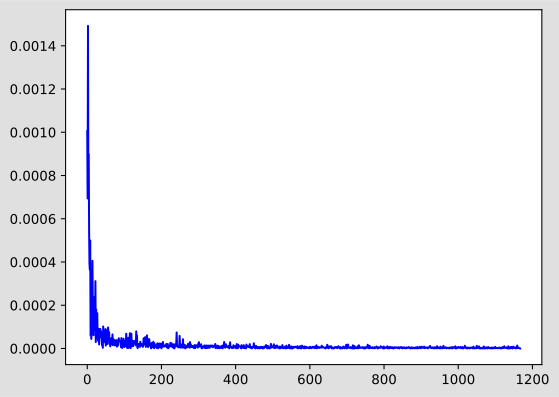
Animation of Monte Carlo KL
Since it may be difficult to know what happens during approximation algorithm, pyAgrum allows to follow the iteration using animated matplotlib figure. As MCBNDistance draws independent samples at each iteration (no burn-in, no Markov chain), its convergence curve is usually smoother than Gibbs’.
mc = gum.MCBNDistance(bn, bn2)mc.setMaxTime(60)mc.setEpsilon(1e-7)mc.setPeriodSize(5000)gnb.animApproximationScheme(mc) # logarithmique scale for Ymc.compute()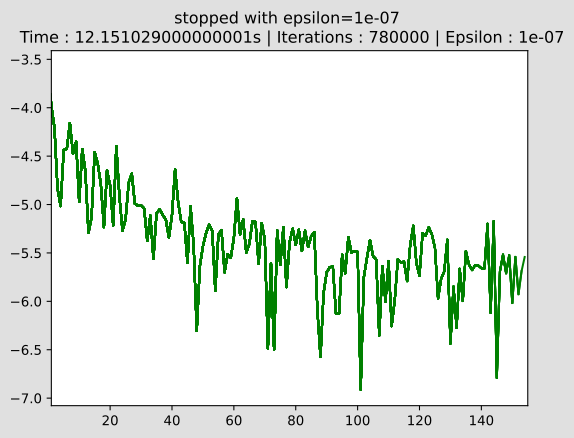
{'klPQ': 4.377305145550049, 'errorPQ': 0, 'klQP': 7.145683751741242, 'errorQP': 0, 'hellinger': 1.0839485427456375, 'bhattacharya': 0.7393133442584102, 'jensen-shannon': 0.680252065106594}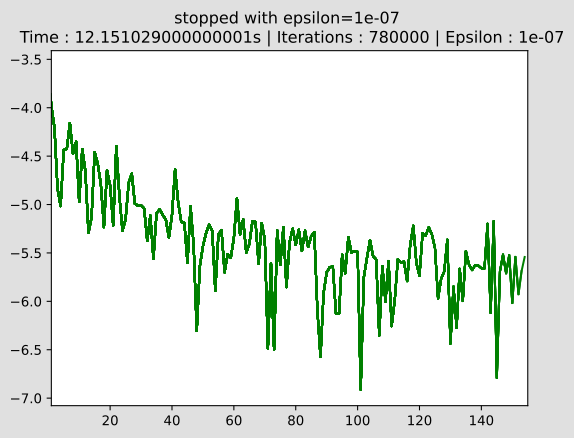
Gibbs vs Monte Carlo : convergence towards the exact KL value
Since bn is small enough, we can compute the exact KL(P||Q) with ExactBNdistance and use it as ground truth. For a range of iteration budgets, we force both GibbsBNdistance and MCBNDistance to run exactly that many iterations (by disabling every other stopping criterion and setting periodSize to 1) and compare how fast their estimate of KL(P||Q) approaches the exact value.
exact = gum.ExactBNdistance(bn, bn2).compute()
iters = [100, 500, 1000, 5000, 10000, 50000]nb_repetitions = 50
metrics = ["klPQ", "klQP", "hellinger", "bhattacharya", "jensen-shannon"]
gibbs_runs = {metric: [[] for _ in iters] for metric in metrics}mc_runs = {metric: [[] for _ in iters] for metric in metrics}
for rep in range(nb_repetitions):  for i, n in enumerate(iters):    g = gum.GibbsBNdistance(bn, bn2)    g.disableEpsilon()    g.disableMinEpsilonRate()    g.disableMaxTime()    g.setPeriodSize(1)    g.setBurnIn(50)    g.setMaxIter(n)    rg = g.compute()
    m = gum.MCBNDistance(bn, bn2)    m.disableEpsilon()    m.disableMinEpsilonRate()    m.disableMaxTime()    m.setPeriodSize(1)    m.setMaxIter(n)    rm = m.compute()
    for metric in metrics:      gibbs_runs[metric][i].append(rg[metric])      mc_runs[metric][i].append(rm[metric])
gibbs_mean = {metric: array([mean(vals) for vals in gibbs_runs[metric]]) for metric in metrics}gibbs_sem = {metric: array([std(vals) for vals in gibbs_runs[metric]]) / sqrt(nb_repetitions) for metric in metrics}mc_mean = {metric: array([mean(vals) for vals in mc_runs[metric]]) for metric in metrics}mc_sem = {metric: array([std(vals) for vals in mc_runs[metric]]) / sqrt(nb_repetitions) for metric in metrics}
fig, axes = subplots(2, 3, figsize=(15, 8))axes = axes.flatten()for ax, metric in zip(axes, metrics):  gm, gs = gibbs_mean[metric], gibbs_sem[metric]  mm, ms = mc_mean[metric], mc_sem[metric]  ax.plot(iters, gm, "o-", color="C0", label="Gibbs")  ax.fill_between(iters, gm - gs, gm + gs, color="C0", alpha=0.3)  ax.plot(iters, mm, "s-", color="C1", label="Monte Carlo")  ax.fill_between(iters, mm - ms, mm + ms, color="C1", alpha=0.3)  ax.axhline(y=exact[metric], color="k", linestyle="--", label="exact")  ax.set_xscale("log")  ax.set_xlabel("number of iterations")  ax.set_ylabel(metric)  ax.set_title(metric)  ax.legend(fontsize=8)axes[-1].axis("off")fig.suptitle(  f"Convergence of Gibbs and Monte Carlo estimates towards exact values\n(mean +/- std/sqrt({nb_repetitions}) over {nb_repetitions} repetitions)")tight_layout()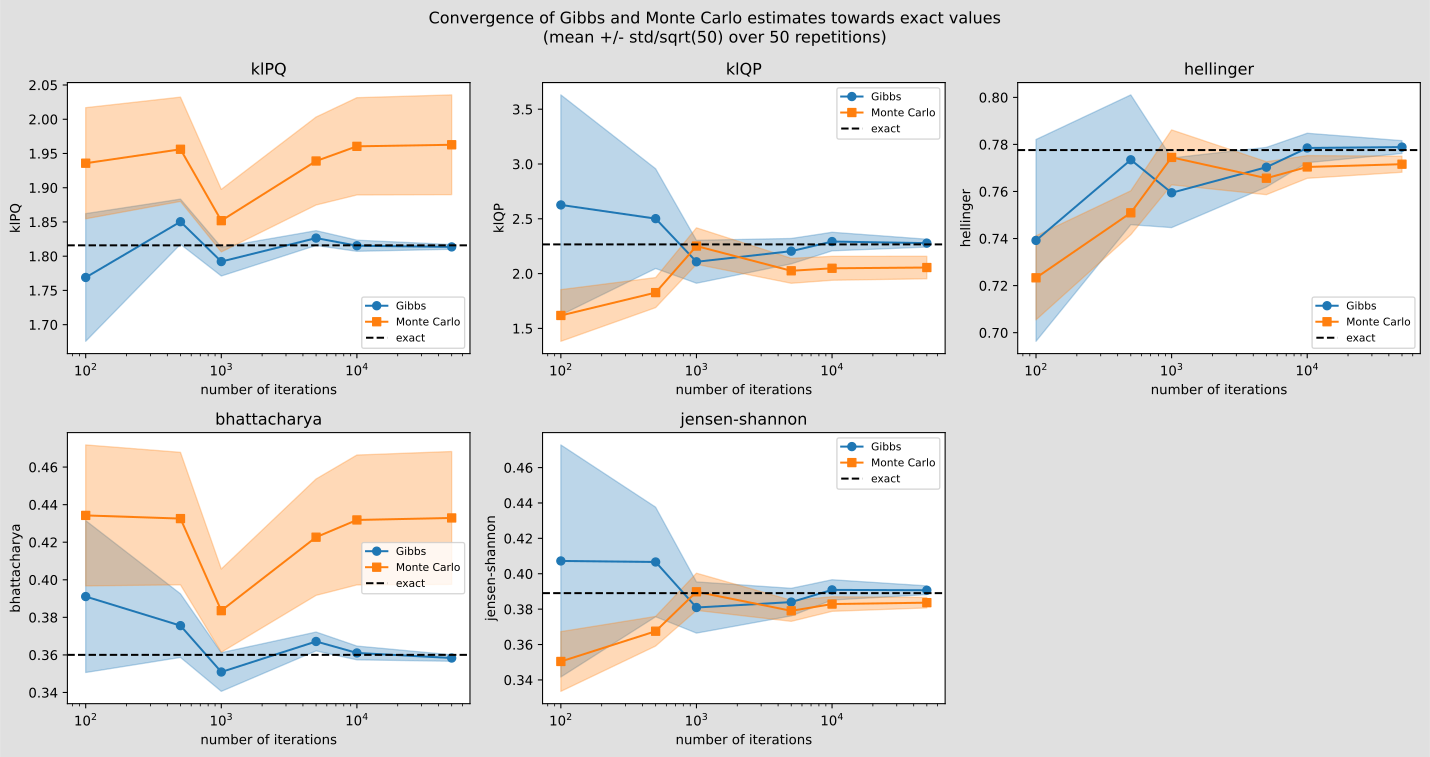
In general, MCBNDistance converges better (faster, with a smaller variance) than GibbsBNdistance for a given number of iterations. This is expected: computing a distance between two BNs does not involve any observation (hard evidence) to account for during sampling, so there is no need for the Markov chain machinery (mixing, burn-in) that Gibbs sampling relies on to handle evidence. Drawing independent samples directly from P is both simpler and, here, more efficient.