


Learning and causality
 |  |  |
import pyagrum.causal_model as gumimport pyagrum.lib.notebook as gnbCausal Model
Section titled “Causal Model”Let’s assume a process with a control on by and a parameter on .
bn = gum.fastBN("Ca->X1->Y1<-Pb")bn.cpt("Ca").fillWith([0.8, 0.2])bn.cpt("Pb").fillWith([0.3, 0.7])
bn.cpt("X1")[:] = [[0.9, 0.1], [0.1, 0.9]]
bn.cpt("Y1")[{"X1": 0, "Pb": 0}] = [0.8, 0.2]bn.cpt("Y1")[{"X1": 1, "Pb": 0}] = [0.2, 0.8]bn.cpt("Y1")[{"X1": 0, "Pb": 1}] = [0.6, 0.4]bn.cpt("Y1")[{"X1": 1, "Pb": 1}] = [0.4, 0.6]
gnb.flow.row(bn, *[bn.cpt(x) for x in bn.nodes()])|
|
|
|---|---|
| 0.8000 | 0.2000 |
|
|
| |
|---|---|---|
| 0.9000 | 0.1000 | |
| 0.1000 | 0.9000 | |
|
|
| ||
|---|---|---|---|
|
| 0.8000 | 0.2000 | |
| 0.2000 | 0.8000 | ||
|
| 0.6000 | 0.4000 | |
| 0.4000 | 0.6000 | ||
|
|
|
|---|---|
| 0.3000 | 0.7000 |
Actually the process is duplicated in the system but the control and the parameter are shared.
bn.add("X2", 2)bn.add("Y2", 2)bn.addArc("X2", "Y2")bn.addArc("Ca", "X2")bn.addArc("Pb", "Y2")
bn.cpt("X2").fillWith(bn.cpt("X1"), ["X1", "Ca"])  # copy cpt(X1) with the translation X2<-X1,Ca<-Cabn.cpt("Y2").fillWith(bn.cpt("Y1"), ["Y1", "X1", "Pb"])  # copy cpt(Y1) with translation Y2<-Y1,X2<-X1,Pb<-Pb
gnb.flow.row(bn, bn.cpt("X2"), bn.cpt("Y2"))|
|
| |
|---|---|---|
| 0.9000 | 0.1000 | |
| 0.1000 | 0.9000 | |
|
|
| ||
|---|---|---|---|
|
| 0.8000 | 0.2000 | |
| 0.2000 | 0.8000 | ||
|
| 0.6000 | 0.4000 | |
| 0.4000 | 0.6000 | ||
Simulation of the data
Section titled “Simulation of the data”The process is partially observed : the control has been taken into account. However the parameter has not been identified and therefore is not collected.
## the base will be saved in completeData="out/complete_data.csv", observedData="out/observed_data.csv"
completeData = "out/complete_data.csv"observedData = "out/observed_data.csv"
## generating complete date with pyAgrumsize = 35000## gum.generateSample(bn,5000,"data.csv",random_order=True)generator = gum.BNDatabaseGenerator(bn)generator.setRandomVarOrder()generator.drawSamples(size)generator.toCSV(completeData)
## selecting some variables using pandasimport pandas as pd
f = pd.read_csv(completeData)keep_col = ["X1", "Y1", "X2", "Y2", "Ca"] # Pb is removednew_f = f[keep_col]new_f.to_csv(observedData, index=False)We will use now a database fixed_observed_data.csv. While both databases originate from the same process (the cell above), the use of fixed_observed_data.csv instead of observed_data.csv is made to guarantee a deterministic and stable behavior for the rest of the notebook.
fixedObsData = "res/fixed_observed_data.csv"statistical learning
Section titled “statistical learning”Using a classical statistical learning method, one can approximate a model from the observed data.
learner = gum.BNLearner(fixedObsData)learner.useGreedyHillClimbing()bn2 = learner.learnBN()bn2Evaluating the impact of on
Section titled “Evaluating the impact of X2X2 on Y1Y1”Using the database, a question for the user is to evaluate the impact of the value of on .
target = "Y1"evs = "X2"ie = gum.LazyPropagation(bn)ie2 = gum.LazyPropagation(bn2)p1 = ie.evidenceImpact(target, [evs])p2 = gum.Tensor(p1).fillWith(ie2.evidenceImpact(target, [evs]), [target, evs])errs = (p1 - p2) / p1quaderr1 = (errs * errs).sum()gnb.flow.row( p1, p2, errs, rf"$${100 * quaderr1:3.5f}\%$$", captions=["in original model", "in learned model", "relative errors", "quadratic relative error"],)|
|
| |
|---|---|---|
| 0.6211 | 0.3789 | |
| 0.4508 | 0.5492 | |
|
|
| |
|---|---|---|
| 0.6183 | 0.3817 | |
| 0.4415 | 0.5585 | |
|
|
| |
|---|---|---|
| 0.0044 | -0.0072 | |
| 0.0205 | -0.0168 | |
Evaluating the causal impact of on with the learned model
Section titled “Evaluating the causal impact of X2X2 on Y1Y1 with the learned model”The statistician notes that the change wanted by the user to apply on is not an observation but rather an intervention.
model = gum.CausalModel(bn)model2 = gum.CausalModel(bn2)gnb.show(model)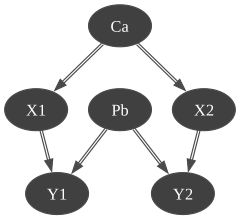
gum.config["notebook", "graph_format"] = "svg"gnb.showCausalImpact(model, on=target, doing={evs})gnb.showCausalImpact(model2, on=target, doing={evs})|
|
|
|---|---|
| 0.5768 | 0.4232 |
|
|
| |
|---|---|---|
| 0.5743 | 0.4257 | |
| 0.5628 | 0.4372 | |
Unfortunately, due to the fact that is not learned, the computation of the causal impact still is imprecise.
_, impact1orig, _ = gum.causalImpact(model, on=target, doing={evs})_, impact2orig, _ = gum.causalImpact(model2, on=target, doing={evs})
Y1 = bn.variable("Y1")X2 = bn.variable("X2")
impact1 = gum.Tensor().add(Y1).fillWith(impact1orig)impact2 = gum.Tensor().add(Y1).add(X2).fillWith(impact2orig)
errs = (impact1 - impact2) / impact1quaderr2 = (errs * errs).sum()
gnb.flow.row( impact1, impact2, errs, rf"$${100 * quaderr2:3.5f}\%$$", captions=[ r"$P( Y_1 \mid \hookrightarrow X_2)$ <br/>in original model", r"$P( Y_1 \mid \hookrightarrow X_2)$ <br/>in learned model", " <br/>relative errors", " <br/>quadratic relative error", ],)|
|
|
|---|---|
| 0.5768 | 0.4232 |
in original model
|
|
| |
|---|---|---|
| 0.5743 | 0.4257 | |
| 0.5628 | 0.4372 | |
in learned model
|
|
| |
|---|---|---|
| 0.0044 | -0.0060 | |
| 0.0243 | -0.0331 | |
relative errors
quadratic relative error
Just to be certain, we can verify that in the original model,
gnb.flow.row( impact1, ie.evidenceImpact(target, []), captions=[r"$P( Y_1 \mid \hookrightarrow X_2)$ <br/>in the original model", "$P(Y_1)$ <br/>in the original model"],)gnb.flow.display()|
|
|
|---|---|
| 0.5768 | 0.4232 |
in the original model
|
|
|
|---|---|
| 0.5768 | 0.4232 |
in the original model
Causal learning and causal impact
Section titled “Causal learning and causal impact”Some learning algorthims such as MIIC (Verny et al., 2017) aim to find the trace of latent variables in the data !
learner = gum.BNLearner(fixedObsData)learner.useMIIC()bn3 = learner.learnBN()gnb.flow.row( bn, bn3, f"$${[(bn3.variable(i).name(), bn3.variable(j).name()) for (i, j) in learner.latentVariables()]}$$", captions=["original model", "learned model", "Latent variables found"],)gnb.flow.display()A latent variable (common cause) has been found in the data betwenn and !
Therefore we can build a causal model taking into account this latent variable found by MIIC.
model3 = gum.CausalModel(bn2, [("L1", ("Y1", "Y2"))])gnb.show(model3)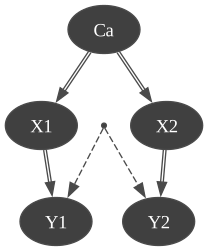
gnb.showCausalImpact(model3, target, {evs})|
|
|
|---|---|
| 0.5725 | 0.4275 |
Then at least, the statistician can say that has no impact on from the data. The error is just due to the approximation of the parameters in the database.
_, impact1, _ = gum.causalImpact(model, on=target, doing={evs})_, impact3orig, _ = gum.causalImpact(model3, on=target, doing={evs})
impact3 = gum.Tensor(impact1).fillWith(impact3orig, ["Y1"])errs = (impact1 - impact3) / impact1quaderr3 = (errs * errs).sum()gnb.flow.row( impact1, impact3, errs, rf"$${100 * quaderr3:3.5f}\%$$", captions=["in original model", "in learned model", "relative errors", "quadratic relative error"],)|
|
|
|---|---|
| 0.5768 | 0.4232 |
|
|
|
|---|---|
| 0.5725 | 0.4275 |
|
|
|
|---|---|
| 0.0075 | -0.0102 |
print("In conclusion :")print(rf"- Error with spurious structure and classical inference : {100 * quaderr1:3.5f}%")print(rf"- Error with spurious structure and do-calculus : {100 * quaderr2:3.5f}%")print(rf"- Error with correct causal structure and do-calculus : {100 * quaderr3:3.5f}%")In conclusion :- Error with spurious structure and classical inference : 0.07722%- Error with spurious structure and do-calculus : 0.17362%- Error with correct causal structure and do-calculus : 0.01588%