


Causality with a DAG only : structural analysis without a BayesNet
 |  |  |
A CausalModel is usually built from a BayesNet : the model then carries the observational CPTs needed to evaluate causal effects numerically. But almost everything a CausalModel does — backdoor/frontdoor search, d-separation, toDot, induced sub-models, do-calculus identification — only ever touches the structure of the causal DAG, never a probability table.
This notebook shows the other constructor : building a CausalModel directly from a plain named gum.DAG, with no BayesNet at all. Every structural operation keeps working; only the operations that genuinely need a probability distribution (observationalBN(), variable(), evaluating a CausalImpact, counterfactual()) raise gum.OperationNotAllowed.
import pyagrum as gumimport pyagrum.lib.notebook as gnbBuilding a CausalModel from a plain DAG
Section titled “Building a CausalModel from a plain DAG”## Z is an observed confounder of X and Ydag = gum.fastDAG("Z->X->Y;Z->Y")
cm = gum.CausalModel(dag)
print(f"hasObservationalBN() = {cm.hasObservationalBN()}")gnb.showCausalModel(cm)hasObservationalBN() = False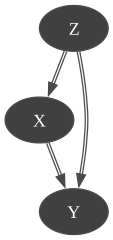
Structural queries work without any CPT
Section titled “Structural queries work without any CPT”Backdoor/frontdoor search, existsArc, parents, children and connectedComponents are all pure graph algorithms on the causal DAG : they never look at a probability table, so they work identically whether cm was built from a BayesNet or from a plain DAG.
print("backDoor(X, Y) :", cm.backDoor("X", "Y"))print("parents(Y) :", cm.parents("Y"))print("children(Z) :", cm.children("Z"))print("connected components:", cm.connectedComponentsList())backDoor(X, Y) : {0}parents(Y) : {0, 1}children(Z) : {1, 2}connected components: {0: {0, 1, 2}}Do-calculus identification (gum.causalImpact) builds the same way : it only needs the causal DAG to find an adjustment formula. Here, Z is found as a valid backdoor adjustment set for the effect of X on Y, and the identified CausalImpact object is returned — but its .eval() cannot produce a numeric answer without CPTs (see below).
## Build the CausalImpact object directly (structural identification only,## no evaluation yet) rather than via gum.causalImpact(), which would eagerly## try to evaluate the numeric result.ci = gum.CausalImpact(cm, on="Y", doing="X")print(f"isIdentified() = {ci.isIdentified()}")print(f"explanation = {ci.explanation()}")print(ci.toLatex())isIdentified() = Trueexplanation = backdoor ['Z'] found.P\left(Y \mid \text{do}(X)\right) = \sum_{Z}{P\left(Y\mid X,Z\right) \cdot P\left(Z\right)}What raises OperationNotAllowed
Section titled “What raises OperationNotAllowed”Anything that needs an actual conditional probability table has no way to work on a DAG-only model, and raises gum.OperationNotAllowed instead of silently returning a wrong answer.
for label, thunk in [ ("cm.observationalBN()", lambda: cm.observationalBN()), ("cm.variable('X')", lambda: cm.variable("X")), ("ci.eval()", lambda: ci.eval()),]: try: thunk() print(f"{label}: no exception raised (unexpected)") except gum.OperationNotAllowed as e: print(f"{label}: raised OperationNotAllowed as expected")cm.observationalBN(): raised OperationNotAllowed as expectedcm.variable('X'): raised OperationNotAllowed as expectedci.eval(): raised OperationNotAllowed as expectedAdding latents, and round-tripping through causalDAG()
Section titled “Adding latents, and round-tripping through causalDAG()”Latent confounders are added the same way as for a BayesNet-based model. And since causalDAG() returns a fully named DAG, CausalModel(cm.causalDAG()) is always a valid round-trip — observed and latent nodes alike become plain observed nodes of the new model.
dag2 = gum.fastDAG("A->B->C")cm2 = gum.CausalModel(dag2, [("U", ["A", "C"])])print("latents:", cm2.latentVariablesNames())print("A->C removed by latent surgery:", not cm2.existsArc("A", "C"))
cm3 = gum.CausalModel(cm2.causalDAG())print(f"cm3.hasObservationalBN() = {cm3.hasObservationalBN()}")print(f"cm3.existsArc('U','A') = {cm3.existsArc('U', 'A')}")
latents: {'U'}A->C removed by latent surgery: Truecm3.hasObservationalBN() = Falsecm3.existsArc('U','A') = True